Insights from the Horses

hay bale at SCSI love the way that horses teach us through their behavior. We humans can learn so much from watching and interacting with them!

A couple of weeks ago, a friend and I were sitting in the pasture with her horse and his herd. The topic of our discussion was boundaries, and how difficult it is to set good boundaries with those closest to us. We were also thinking about how hard it is sometimes to accept and honor the boundaries that others—again, especially those close to us—set for themselves.

Boundaries are so important! They keep us from being “run over” by other people. Without good boundaries, we can find it impossible to say “no” to requests or to avoid emotional entanglements even when we know they are unhealthy. We can end up taking responsibility for so many things that aren’t really ours at all. The end result, for me at least, is a feeling of being overwhelmed and resentful.

As we talked, the horses were going about their business, ignoring us for the most part. Two or three of them were standing around the hay munching quietly, more or less evenly spaced around the bale. Then the lead gelding walked up to the hay. He lowered his head slightly, pinned his ears, and just LOOKED at the horse on his right.

Instantly, the other horse stepped back and moved to the opposite side of the hay bale, leaving the lead gelding with plenty of space. The other horses adjusted their positions slightly and everyone went back to eating. No fuss, no hurt feelings. They never questioned the hierarchy that allowed the lead gelding to claim his space, and they didn’t appear to take it personally when they were told to move.

My friend and I laughed at the “lesson” that was offered in such a timely manner. “Here. Let me show you how it’s done.”

Boundaries are a vital part of the herd dynamics, and horses learn about them from their mothers and their herdmates when they are very young. They are just part of life. If only it were so easy for humans!

A second “lesson” occurred last weekend, when I watched another friend working with a horse at the Ranch. She was having a hard time getting the horse to go through an obstacle. He had been doing very well earlier in the afternoon, but had started to refuse requests. My friend was getting more and more frustrated.

It’s always easier to see what someone else is doing than to see it in ourselves, so I was able to see that the horse was refusing because he felt her frustration and anger. I suggested that my friend ground herself and bring her energy level down. As soon as she dropped her energy, the horse dropped his head and moved much more quietly.

Talk about instant feedback! That’s the best part of working with horses in this kind of situation. They respond to what they feel in the moment, and as soon as that feeling changes, their behavior changes, too.

They’re so helpful in my line of work, because a client can see the change for themselves. It’s not just my opinion—it’s the horse himself who interprets their actions and energy. And when the client changes, the horse’s behavior changes—simple as that.

Wouldn’t it be great if humans were so easy?

Happy

Snapshot 1 (6-8-2013 1-23 PM)

Had a lovely afternoon on Wednesday. Galahad, when he first caught sight of me coming through the fence, galloped over. It was clear that he was really glad I was there, and happy to come over and greet me. I squirted him with some fly spray and we chatted for a couple of minutes. Then I walked off. He followed me for a ways, then trotted back to the other geldings, who were standing in and around the shed.

He went back to his herd the same way he had come to me—happily. It was obvious that he really liked going back to the herd. The key word is “happy.” It wasn’t that he was just going back to the herd because that’s what he was supposed to do, or that he just kind of wanted to, that he didn’t have anything better to do. He went back to the herd the same way he came over to see me—he was happy! He really liked being with his herd—he exuded happiness.

Then a few minutes later, one of the horses took off at a walk toward the water tank (with a planned stop to check on me, which I discouraged with a wave of my reed). The other three followed—and again, I could feel how happy Galahad was to be in his herd, to hang out with his buddies.

I begin to see what Carolyn Resnick’s method is after. There will come a point where Galahad will be happy to do whatever activity I want to do, too. With his herd, it doesn’t look like it matters to him in the least what they’re doing. Eventually that’s the kind of feeling I’m going to have with him. It’s really beautiful to watch, and I’m excited to look forward to that.

It will take time, but however long it takes, it will be so worth it! He and I have years. There’s no rush.

Chasing Insight

2013-05-18_15-37-45_105 (Cross-posted from “It’s An Alchemical Life”)

I can always tell when I’m learning something that’s really important and difficult for my psychological growth: The exciting feel of sudden insight gets slippery and hard to hang on to. I “get” it, then forget it almost immediately. I try to drag pieces of it back into memory, but it slips away again.

I have a theory that this occurs whenever we get close to something important, something our ego is having a hard time with. When it happens, It fun to watch the understanding slide in and out of awareness.

Yesterday, I had my cell phone with me, thank goodness, during one of these events, so I could record my thoughts. The insight has to do relationships, which have so often been problematic in my life. The understanding itself is important to me, and hopefully to some of you reading this. But what I especially want to share here is the process. I wonder if others have similar experiences.

I recorded the first flash of understanding while I was getting ready to take a shower (Why is it that we do so much of our best thinking in the bathroom?), but by the time I actually got into the shower, I couldn’t for the life of me remember what it was. Frustrating!

The recording is fascinating: I started out excitedly talking about the background of the situation that led to the insight, but then, you can hear it fade away. “This is so hard to hold on to! It has to do with us all being connected through Source…. [long pause] …but I can’t remember what it was, exactly, or how it fit in.”

Half an hour later, I sat down beside my waterfall and turned on the recorder:

“It’s funny, when these insights show up: They’re so squirrelly. If I could sit down and really focus on them and get them down I feel like I could hold on to them. They’re evanescent. There are things in this life that you can see so clearly, but then when you reach for them and try to catch them, they slip away…. Or like when you’re watching a tiny wild animal that keeps flitting through the underbrush, but if you go to grab it, it’s gone. These really deep insights are like that, especially at first. You can feel them, see them out of the corner of your eye, but when you look straight at them and try to put words to them, they just vanish.

“Right now, I can’t even put my fingers on exactly what I wanted to say when I started this recording! But I guess it’s good, in a way, because that means they’re THERE; they’re just shy. They’re like that tiny animal—if you look too hard at them, if you use “hard eyes,” they disappear. But if you just let them be, let them grow, you’ll get to see them eventually. That’s enormously frustrating for this time-bound ego of mine!

“I want so badly to get this essential wisdom down in some form, and it slips away. It’s exactly like trying to catch a dream when you wake up…. Maybe it’s the same process. Or it’s like trying to SEE in the imaginal world, which I can’t do well—I can’t see with my “hard eyes” in the Imaginal. Sometimes I can see with soft eyes. Sometimes I can’t see at all, but I can perceive with other senses.”

Some time went by, and I did other things. But I still wanted to try to remember what it was that felt so important.

“Let’s see if I can backtrack and go back to where I first saw the ‘animal.’ I was thinking about relationships, and how desperate I always used to be to find that ‘perfect relationship,’ the relationship that would ‘complete’ me. I was thinking about the repeating patterns—and then this amazing insight appeared! I still can’t remember it!

“See, here we go again: There are ‘bushes’ in the way of whatever it is that I’m chasing! I should be just allowing it to show itself. But’s hard to feel like you’re so close to an understanding, and yet be unable to grasp it. But actually, it’s sort of a magical place, too. Frustrating but magical.”

And back again to the beginning: “So I was getting ready for the shower, wondering about relationships, and puzzling over the why of it. Oh—wait! I remember: It was the idea of being desperate for a relationship that would somehow let me ‘merge’ with another person.”

Aha! I finally had a tenuous hold on the insight that had shown itself!

“Oh, that’s interesting. My thought of ‘merging….’ What just now flashed through my head was ‘abdication of responsibility.’ Responsibility is the wrong word…. Abdication of opportunity, maybe. Trying, out of pure ignorance, to avoid the responsibility for developing myself as myself. And being quite unaware of my connection to Source.… Out of loneliness and fear I would reach for a relationship, but at some level—Higher Self or higher wisdom, higher consciousness—I was aware that it wasn’t a valid quest. It wasn’t the right question—not the concern or investigation that I came here to do.

“It’s going to take a long time to wrap my head around this. It’s good to have some kind of insight—I’ve not had that before, or only fleetingly. This is the longest I’ve been able even vaguely to hold this stuff…and it just keeps slithering away. That is so cool!”

Looking back, I think that the process I observed is what James Hillman refers to when he says (I’m paraphrasing here), “Don’t drag a dream image kicking and screaming out into the light of day.” This feels like the it’s same kind of thing. You have to let your consciousness expand enough to appreciate the nuance of what’s coming through, and then let it emerge.

When an insight is so slippery, I’m always sure that it concerns an area where I’ve struggled long and hard—a difficult part of my life’s journey. Today, it’s about finding myself and my own strength, and about embodying my true self.

This one is so interesting: We know we’re all connected through Source. At this point I don’t doubt that. The challenge is to BE ourselves, as we take form in this world: to be true to our incarnation, our “becoming flesh,” and at the same time integrate, somehow, the higher wisdom of our true self, our innermost self. It’s an enormous challenge. How can we integrate the truth of our being with the truth of our embodied state?

It seems I’m being reminded of the question.  I notice that nobody is offering any answers.

All right. I think I’ve yanked this new understanding as far as I can into the dayworld. Time for it to be on its way, perhaps to show up another day, between the trees, as I watch with soft eyes.

Horses know the real story

Galahad 1 by Aiming High PhotographyPeople often ask me how I can get so much information about how a person is feeling just from watching them hang out with a horse.

As part of a class I’ve been taking this spring, I’ve been recording some of my own interactions with my little herd, and thought I’d share a couple of videos with you. I think you’ll begin to understand.

First, watch this clip of me and Galahad back in April. Watch the interaction. Watch Galahad’s approach, his eyes, his expressions, his movements.

Now, watch this second clip, taken a couple of days ago. Same horse, same human. Look for the same kinds of information, and compare it with what you noticed in the first video.

See the difference?

In both cases, I FELT perfectly calm. But in the recent one, my conscious perception didn’t reflect what was really going on. I wasn’t aware of my upset, but Galahad was. That evening, I edited the video and noticed his body language, which I had not noticed in the moment.

I realized that in fact I had been feeling absolutely frantic that day. I had a deadline to meet, and needed to do the video work. There was a storm coming, so I had to get it done before the weather got bad. And there were about a million tasks that needed doing at the same time as I was sitting down with my horse. None of this was conscious at the time. I enjoyed my time with him, and thought that my mood and energy were just fine.

Horses are both prey animals and herd animals. Both of those conditions require them to be exquisitely tuned to body language and energy. This is one of the things that makes them so very helpful in my consulting work. They will tell me, through their own body language, exactly what’s going on with the person they’re working with. They never lie, and they never hide their own feelings.

It takes a sharp eye and lots of experience to be able to use the information the horses provide. My training in psychology allows me to help my clients become aware of their emotions and their energy. Awareness must always come first, before you can take action to change something.

The horses know us better than we know ourselves. I’m grateful to Galahad for pointing out how agitated I was that afternoon. Now I can work to become more aware of what’s really going on!


(The lovely photo is by Aiming High Photography.)

“Snowman”: Day Two

Snowman 1Last night’s apprenticeship class was not quite as stressful as the last one, but I sure learned a lot.

Pretty quickly, we students were told to go get us a horse, any horse we wanted to work with, and halter them and lead them out into the arena. After the last session, I wanted to work with any horse on the property other than “Snowman,” the homely little pony from last week. I started down the barn aisle to get one, and found myself (not surprisingly) opening the door to Snowman’s stall.

I have been through this kind of learning experience too many times to fool myself into avoidance. It never works.

This time, I didn’t rush the initial contact. It was easier to read the horse without those six extra pairs of eyes watching me. This time, I could see that while Snowman can indeed be a mean little pony, he’s mean because he’s utterly terrified. That crazed, white-eyed look of his is NOT his natural state—not at all. It’s just that he cannot relax if there’s anyone—human or equine—in his immediate vicinity.

No nervousness on my part this time—that made our interaction easier. A couple of times during the haltering process (which probably took ten or fifteen minutes), he dropped his head and gave a big sigh, which didn’t happen last week, for sure! It went well, and this time I did make it all the way to flexing him—Da Boss was standing outside the stall for that part, and helped me get it pretty much correct.

Little Snowman is a stinker. He challenged me by changing sides without my asking, by insisting on walking behind me when I was leading him, by trying to run away when I asked him to move up next to me (where I could see him and he couldn’t bite), by insisting on trying to back out of the round pen without permission. These were his choices, for the most part. I hadn’t made too many mistakes yet.

But then the exercise of the night was introduced: using a training stick to ask the horse to yield his hindquarters and then back up, while we maintain a safe, four-foot distance from him. It’s a basic and very important safety move that a handler needs to be able to obtain from ANY horse. “Move your hind end away from me, and back up out of my space. Thank you very much.”

Hmmm…. I never use a stick any more with my own horses, and never got good at it back when I did use one.

Our first efforts resulted in a little white horse racing madly around me, trying to get away from me and my stick. Huh? That’s not what I had envisioned. Poor little tyke! When I would get him stopped and backing up, he was literally shivering with fright. I was horrified!

So eventually, I yelled for help, and Jay came over to explain what I was doing wrong (or at least the biggest things I was doing wrong!). He demonstrated, and although Snowman did run around, he wasn’t as frantic. After the backup, he came up to Jay with his head lowered, his eyes soft (!!), and practically glued his little head to Jay’s arm. That’s when I realized how desperate this little guy is to find someone he can trust. He just needs a leader to keep him safe, so that he can let his guard down.

Wow.

So I tried it again, this time holding the stick correctly and asking in a fair and consistent way throughout the entire exercise. This time, Snowman ran less hard and backed up more willingly. It wasn’t perfect, but it was better, and the pony wasn’t shaking when we finished.

Keep my energy down, be fair and consistent, and give the horse time to respond before escalating my aids. These are so simple! And yet the effect on the horse is dramatic. They’re all things I know in my head and thought I was doing, but it was obvious that I was not doing them properly. I learned a lot!

I’m discovering there’s a serious downside to working only with my own little herd. I know my own horses way too well, and they are well trained. That’s great, but it also means that I can get sloppy without realizing it, because the horses behave so well even with sloppiness. That’s a credit to our bond, but it doesn’t help me with other horses who do NOT know what this is all about.

But I am proud of myself for one thing: Despite what I would have considered a dismal failure a few years ago—maybe even a week ago!—last night I was pretty happy with the evening because I learned not only new techniques but also was able to see more of what I need to work on. I could get genuinely excited about asking Jay, “Teach me a better way!” and not feel bad that I had to ask.

Maybe that doesn’t sound like much to some of my readers, but it’s HUGE for me: All my life it has seemed, to some part of my psyche, that I MUST BE PERFECT or something terrible will happen. That sense is fading quickly. What a blessing!

Yeah, I still have a big ego, but my ego and I are starting to part company a little more once in a while—just enough, and long enough, for me to step back and gain perspective on the situation I’m facing. That’s when real personal, spiritual growth can begin anew.

Grateful….

The Last Week of Class

Snapshot 3 (5-4-2013 9-50 PM)This is the last week of my class with Carolyn Resnick. Yesterday I sent in my last video for the coaching call on Monday. Galahad and I will continue to work with this material through the summer, and then have another go this fall, when the next class starts.

It’s been a pretty amazing experience! My relationship with Galahad has shifted in wonderful ways, just in these last six weeks. The biggest change is that I’m beginning to see his playful nature more and more—it’s subtle, still, but there’s a sparkle in his eyes that wasn’t there before. He enjoys my company, and seems to look forward to our interactions.

Here’s an example. A couple of days ago, he and I were sharing space in Midnight’s paddock, where we do some of our work with clients.

Midnight was temporarily locked in his stall so that Galahad and I could work. Midders was NOT happy about that, but he had simply walked UNDER the rope that I was using to keep the two horses separated. The rope stopped Galahad, but not the little black horse—he’s WAY too smart! So I closed his rear stall door. Here’s Midnight in jail, kicking his stall door.

Galahad hadn’t been in the paddock for nearly a month, and you know horses—any time anything changes, it needs to be investigated. In this case, the trees on the south side now had leaves that danced in the breeze, and there were buttercups (inedible but lovely) growing in the center that hadn’t been there before. He took half an hour or so to explore everything.

I sat quietly, reading my book (love my Android phone!), for the first half hour. Then I decided to clean up the paddock, so I got out the rake and went to work. And lo and behold, I had HELP! Or at least I had company. Galahad was so funny about it, so curious, so friendly—here’s the video. Not something he would have done two months ago! I love the change.

The other noticeable effect of the course shows up not with Galahad but with HRH Princess Nevada: She’s royally pissed at me.

It seems to have started when she realized that I was spending a lot of time hanging out with Galahad, and not with her. Because of time constraints, pretty much all I’ve done with her lately is bring her food, and then only if she is willing to come to me and get it. Nevada is jealous—seriously. Anyone who thinks horses don’t get their feelings hurt and sulk hasn’t been around them much! Nevada is the queen of sulkiness.

Day before yesterday, she and her friends (the lead mare and the second in command) were hanging out near the shelter, napping in the shade. I went to call her in for dinner. She looked at me, pawed the ground with her forefoot in the way that means, “Come over here! Come pay attention to me!” or, in this case, “Bring it over here! I’m hungry!” I called her again; she didn’t move anything but that front foot. I set the pan on the ground and stepped back to “draw her in.” She pawed a couple more times, then turned her butt to me and walked off.

Pretty clear communication! Maybe she’s not hungry, you say? Nevada is ALWAYS hungry.

Yesterday, she and the other mares were halfway across the pasture when I got ready to feed her. I whistled to her, and watched her head come up to look at me. She’s always easy even for me to spot, because of that wide white blaze. Usually, once her head comes up, she’ll start walking over to see me. But again, no dice. She put her head back down. I whistled for her again. Not only did she ignore the whistle, but she turned away and walked over to her friends.

I have been dissed. There is no other way to read this.

Honestly, I do believe she’s punishing me. It’s not the first time: I remember the time I embarrassed her in front of her friends, and the next day she refused to be caught. So yes, horses do get their feelings hurt.

Now that the Carolyn Resnick class is over until fall and Galahad and I don’t have video deadlines to meet, I will go sit with Nevada, too. I do feel a little bit bad for her… but she is such a stinker!

Oh, what a day….

Snowman 2

My facebook post this evening hardly scratched the surface of my day:

What a day! Hour+ drive to the Rescue Ranch this morning; something over six straight hours of instruction with Da Boss; a quick burger and fries at the gas station; hour+ drive to my barn to spend 2 hours with my guys. I’m EXHAUSTED. Wow….

The rest of the story: It was a humbling experience at the Ranch today. Fascinating, but humbling. We’re on Day Two of the first block of the apprenticeship program, which I’m taking this spring. Each of us students was to approach a horse in a stall, halter it, flex it, lead it around in the stall, and remove the halter. Sounds easy, right?

Wrong.

Not one single one of us students thought it was easy. Looks that way when Jay does it, but when WE get in there? Suddenly, with six pairs of eyes on you and a horse that you don’t know, everything you have learned goes right out the window.

I was in the same boat as everyone else. I really don’t think Jay believed me when I told him that I do NOT know, nor do I pretend to know, how to do this properly. What he forgets is that it’s been more than two years since he tried to teach me that skill, and since then, I bet I can count on the fingers of one hand the number of horses (other than my own) that I’ve taken out of a stall. My horses are all pastured, anyway, so I don’t even get to practice on them.

Once a horse is OUT of its stall, I’m just fine. But…getting him there? During all the months I worked with Jay developing the apprenticeship program, I never actually got completely over my fear—it’s more than a bit scary to encounter a horse in a 12 by 12 stall. And I’m still a little nervous about the idea.

So when my turn comes, Jay says, “You ready? Talk us through it.” Yeah, right.

OK. So I pick this little white pony with a gray mane and tail and a face that only a mother could love (I may be exaggerating a bit). And then I totally—TOTALLY—misread everything the pony has to say. Every mistake in the Beginner’s Book of how NOT to approach a horse. It was not pretty. My first clue was when Jay said, “If I were you I wouldn’t have gone in there just yet.” Oh, great….

The good news is that I did not get kicked or bitten, and I did get the halter on the horse’s face. But Jay intervened (one million thanks, Boss!) before I had to flex the little beggar…I mean, the little pony.

Wow. I knew I wouldn’t be the greatest at it, but I had no idea I would be that bad, either. I have no excuse other than distraction and lack of focus on my part. It wasn’t the pony’s fault—he was absolutely clear in his communication, if I had been able to read it.

The other good part, though (and I actually have to give myself credit for this), was that I did not dissolve in tears or get overly embarrassed by it. A little bit…and a little bit angry with myself. But really, if I never make a mistake, how the heck am I ever going to learn? So I am learning and growing, and developing a better ability to laugh about this kind of thing and get on with the learning.

Sheesh.

So after six straight hours of instruction and working with the rescued horses, I head to my barn to work with my own horse—on the halter, this time. My plan was to halter him exactly the way I had been shown, right? Practice what I’d just spent half the day supposedly learning. So I get the halter on Galahad with no problem at all…only to realize after the fact that I had done NONE of the steps in the right way.

Seriously.

Oh well. Galahad doesn’t know it, and he’s so good and so used to my way of communicating that he’s just fine. But that didn’t stop me from beating myself up about it.

I’m sharing this mostly as a kind of baseline measurement: putting the experience into words right after it happened (or six or so hours later, anyway) so that I can remember what it felt like. It’s good for me to remember what it’s like to be an absolute beginner at something—that way, when I’m teaching someone else, I can understand their position better.

The other reason, though, is that sometimes when people see me with Galahad, they think I’m some whiz kid horsewoman—but that’s not entirely true. I’m good—but I still have a LONG ways to go. And the only way to get better is to screw up, sometimes royally. Ouch! But hey—like Anne of Green Gables said, “Tomorrow is another day, with no mistakes in it…,” yet.

[Update, 16 May 2015. In retrospect, after 2 years of studying liberty work, I have come to believe that I did NOT mis-read this pony’s attitude. Yes, he was a pushy little guy, but he was also scared witless by a lot of what was going on at the time. My gut reaction to him was that he was curious about me, and that as long as I didn’t pose a threat (from his viewpoint) he wasn’t going to do anything nasty. Caution was required, of course, as with any horse, but things would have gone just fine. Anyway…we live and learn.]

I guess I have to believe her….

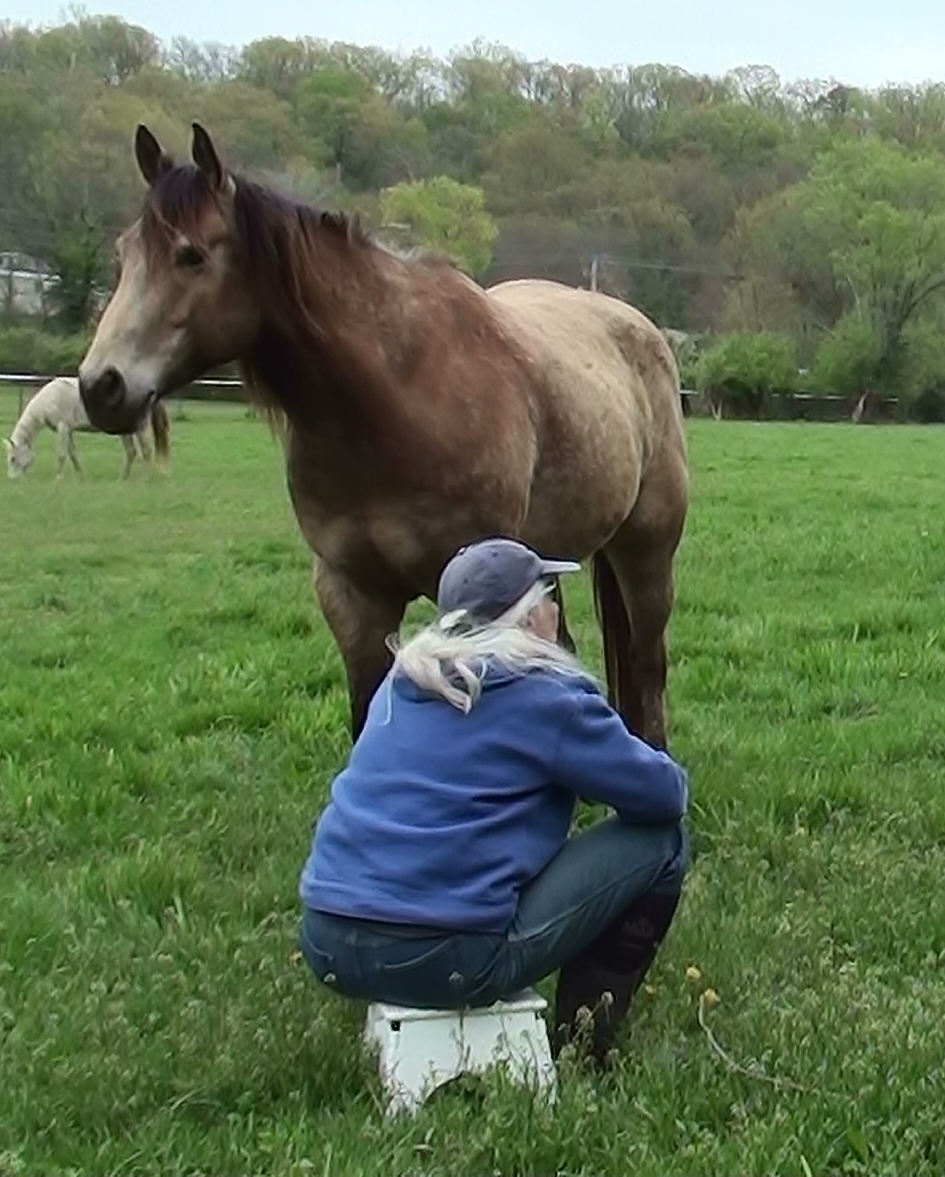
I guess I have to believe herThe video I put together for this week’s conference call in Carolyn Resnick’s class was mainly to show how my relationship with Galahad has grown since she reminded me to focus on what was going RIGHT. It was made up of clips showing my horse and me hanging out in the pasture, walking together, watching the “scary” tractor together, and me feeding a connected and respectful horse some of his favorite treats while I sat on a stool in the pasture.

I must have watched that video a hundred times—the connection we share is so obvious and so lovely.

When my turn on the call came, I started out explaining why I hadn’t done any of the exercises for that week. I was feeling vaguely guilty about that, but I had done what FELT RIGHT in the moment.

And what did Carolyn think about it? She LOVED it. She pointed out all the things that were good about our work, and most importantly, she noticed how connected we were, and how much Galahad seemed to be saying, “I love knowing how to be with you!”

I suspect that everyone who interacts with Carolyn much notices how immensely intuitive she is. She sure proved it to me! Her next statement was “I think you’re going to be able to take a lot of loneliness out of this horse.”

Loneliness? I asked her to say more.

“When I saw this horse before,” (in my earlier videos for the class) “I saw a deep loneliness. He had given up himself. His way of being was ‘I’m just going to be. I’m not going to have feelings about anything. My feelings left me a long time ago, and I can get through life without feeling.”

Well, as you can imagine, I burst into tears at this point, remembering how Galahad had been abandoned by his people and left to starve to death. Galahad has always seemed somehow shut down, with a lack of enthusiasm for any kind of training. I’ve never been able to find out what games might interest him. He just gets quiet, sullen, and stubbornly resistant to doing anything he’s asked to do. I had despaired of ever getting through to his real nature!

“Kay, you do have a natural ability to stay connected in the process of everything you do. It’s just in your nature. I’m not going to tell you how to proceed, because you’re steering your own ship right now, and that’s exactly where I want you to be.”

Thank you, Carolyn. What an affirmation. And Carolyn does not blow smoke; she says exactly what she means.

So I guess I have to believe her. I’m developing my natural ability for horsemanship, my feel, my intuition; and all that’s translating into developing and maintaining an amazing relationship with my horse.

It’s interesting: I have often felt that way. A part of me knows that I can achieve and maintain a connection with almost anyone, whether they be horse, human, or feline, through whatever challenges come along. But to hear it stated from someone I respect so much is humbling. And to have it stated in relation to my beloved horse—that’s incredibly … I don’t even have a word for it.

Now, it’s going to take me a long, long time to get to where I can believe it in the difficult moments. Right now, I’m having a hard time remembering it from one moment to the next!

Example: I was out in the pasture with Galahad the other day, just hanging out. Then it occurred to me that I “should” do some of the other exercises. Are those warning lights EVER going to start flashing when this word shows up??

So I tried moving him along, ever so gently. He snorted and scooted just a little, with his nose still in the grass. It was clear that he was NOT in the space of quietly accepting a nudge from me. I had known that before I asked—I can read that horse like a book.

So I stopped asking him for anything at all, and went back to just hanging out.

The good news about this little interaction is that I recognized how good my “feel” is. I can tell exactly how much pressure, or “ask,” he’s able to tolerate without getting upset and moving off. And the bad news? None, I guess, except that once again I acted on a “should” and not on my own intuitive “feel” for the situation.

Well, awareness is always the first step in changing anything. When I asked Carolyn about it in the classroom, she reminded me not to push any agenda—just let things unfold in the moment.

OK. Deep breath…and back to unfolding.

The Real Galahad

Snapshot 1 (5-4-2013 9-54 PM)I’ve said for a long time that I want to know who Galahad is–his true nature, his personality without the veneer of enforced politeness, without the sullen acquiescence that he all too often shows. I want to know the real Galahad.

Well, it seems that with these new methods I’m learning, he feels much freer to express himself. Don’t get me wrong–he’s still respectful to me, and mannerly with others. That part hasn’t changed.

What is new is the energy he has about him, and his expressiveness. There’s a happy spirit and a fire in him that until recently I only saw when he was with his buddies. Now, I see it and feel it whenever we’re together. That’s a wonderful thing, to see him open up with me like that!

As I was leading him back to the pasture this afternoon, Galahad was anxious to get to the bucket of soaked alfalfa cubes that my friend was carrying. As I’ve said before, on a scale of one to ten, ten being a crazy bronc, Galahad’s bad-boy act is about a three…well, maybe a four. But he can be a handful, and we had to do some backing, turning, and repositioning. He did it all cheerfully enough, but you could tell he was full of himself.

His confidence has gone way up, even in his herd. That sounds odd, but it really seems to be true. I noticed him moving one of the other horses off with just a look the other day–and that was a horse who terrorized him when he first arrived.

About halfway across the pasture, I decided to turn him loose so that he could run and play. Knowing he was feeling frisky, I was careful to take the halter off while moving his back end away from me in a pivot on his forefoot. Good thing, too: he took off at a gallop as soon as I let go.

Beautiful to watch! He soon came circling back at a canter. I held up my hands in front of me and leaned forward: “Halt!” And he came to a sliding stop about fifteen feet away. Good boy!

After that burst of energy, he walked with me the rest of the way across the pasture, and I noticed an odd thing: he was better behaved OFF the lead than he had been ON the lead. Not sure of the explanation….

Anyway, we’ll continue doing traditional groundwork as we move along with Carolyn Resnick’s liberty methods. Giving him more freedom also means I have to step up a notch in leadership. But that’s just fine.

We’ll get there, my Galahad and I.

Lessons With Carolyn Resnick: The Waterhole Rituals

4-28 STI’m enrolled in Carolyn’s Waterhole Rituals* online course this spring, and it’s been a real eye-opener!

First of all, it’s freed me of my obsession with needing to “do something” with my horses every time I’m with them. That attitude has been crippling, to the point where there have been times when I’ve dreaded going out to the barn because I haven’t know what my agenda should be. All I knew was that I should do something with them—but what?

The very worst thing about that mindset is that it has hindered my relationship with my horses, particularly with Galahad. “Work”—groundwork drills, riding around and around in the arena, and that kind of thing—are definitely not his favorite activities. In fact, he doesn’t enjoy them much at all most of the time. He did absolutely everything I asked of him, but clearly, he didn’t enjoy it.

What Galahad really does enjoy is having me around, close by, and then going about his own business. The few times I allowed myself to do that, he loved it! He’d go graze, then come and check on me, then wander off to graze again. He’d follow me when I left the pasture, wanting more.

More what? “Doing nothing?” Apparently so, but I “knew” that was bad. That was just spoiling the horse. I wasn’t riding him, wasn’t doing groundwork with him, so in effect I wasn’t doing anything with him. Bad Kay. Then I’d see others riding their horses on the trails and in the arena, but I was still afraid to do that with him. So I’d get in the car and drive away, feeling inadequate, kicking myself, and dreading my next visit to the barn.

Lots of tears were shed over this, believe me! I love my horses—all of them!—and they love me. I knew that—but it wasn’t enough.

I discovered liberty trainer Robin Gates via a friend who took a 4-day intensive from her last year. Through Robin’s site, I found her mentor Carolyn Resnick and the online Waterhole Rituals course. Watching Carolyn and Robin and their students dancing with horses at liberty, without bridle, saddle, or even a halter, was mesmerizing. That’s the kind of relationship with my horses that I want, I said to myself. So I signed up.

Now, here’s the interesting part: Carolyn’s method* relies on enacting rituals that horses do with each other in their natural state. What’s the thing that horses do most when they’re together? Hang out, “doing nothing” except grazing. So the first of the Waterhole Rituals is called Sharing Territory.

First and most basic: hang out with your horse in the pasture. I’m not going to go into any detailed explanations of any of Carolyn’s work—for that, you’ll need to get her book or videos, take her online course, or (best of all) attend a clinic. The important thing here is that our class assignment was to hang out with our horse in the pasture or arena. That’s it, at the beginning. Forget about any agenda, and don’t even pay attention to the horse unless he becomes a pest.

That is all.

Oh, yay! An assignment! That means I have permission to just hang out and do the thing that Galahad loves most in the world.

But then the second lesson in the course was explained, and the third…and all of a sudden I felt overwhelmed, behind the eight-ball, and totally inadequate. When I made the class videos of Galahad and me doing the lessons, I looked hard and could see where he was arguing with me, where he was being belligerent (though in his mild, inoffensive way). Or so I thought.

Carolyn, on our conference call, said, “I don’t see him as being belligerent at all!” Huh? And then, when I asked what to do when he doesn’t mind me, she said, “Don’t give it any attention. Don’t focus on it. Just say, ‘Look at how my horse is hanging out with me!’ and just keep your focus on that.”

Oh rats. I get it. It’s that old voice from my past that says, “If you’re sitting around ‘doing nothing,’ you’re wasting time. No sitting around slacking. You have to have an agenda, and you have to be doing something with your horse. And YOU MUST MAKE HIM MIND!”

Rats.

It wasn’t the first time I’ve recognized that particular inner voice and that old “recording” that plays in my head all the time. But at least now I’ve seen it at work with Galahad and me—and I have a way to erase that tape and make some new decisions for myself.

The result: the last couple of weeks I have pretty much just shared territory with my horse, and have not worried about moving beyond that. He and I are growing closer and closer—I can see his attitude change in step with mine. He enjoys my company when we’re together even more than before because he understands that I don’t want anything from him. He’s become more interested in following my leadership in the pasture and outside. It has become so much easier on both of us, and we look forward to our time together.

So now I see why Carolyn said, at the very beginning of the course, that her focus in the course is not on “how far” we get, how many rituals we “complete,” during our time in the class. My understanding is that the focus is on the quality of the relationship that we develop with our horse. There isn’t, and can’t be, a set time frame. It takes just as long as it takes for each step, and the work together is never finished. There’s always more to learn. And along the way, you discover the magic. That’s the point: the magic of connection.

So: “horse time.” Back to grazing. Back to being together, in the moment, and letting everything else drift away except for the love and the silent connection. Another life lesson.

Wow….


* Disclaimer: I’m a student, and I don’t claim to know ANYTHING about Carolyn Resnick’s methods. Don’t take anything here as coming from Carolyn, other than the quote. For information about her courses and methods, see her web site and/or her published material.