Waltzing with Galahad

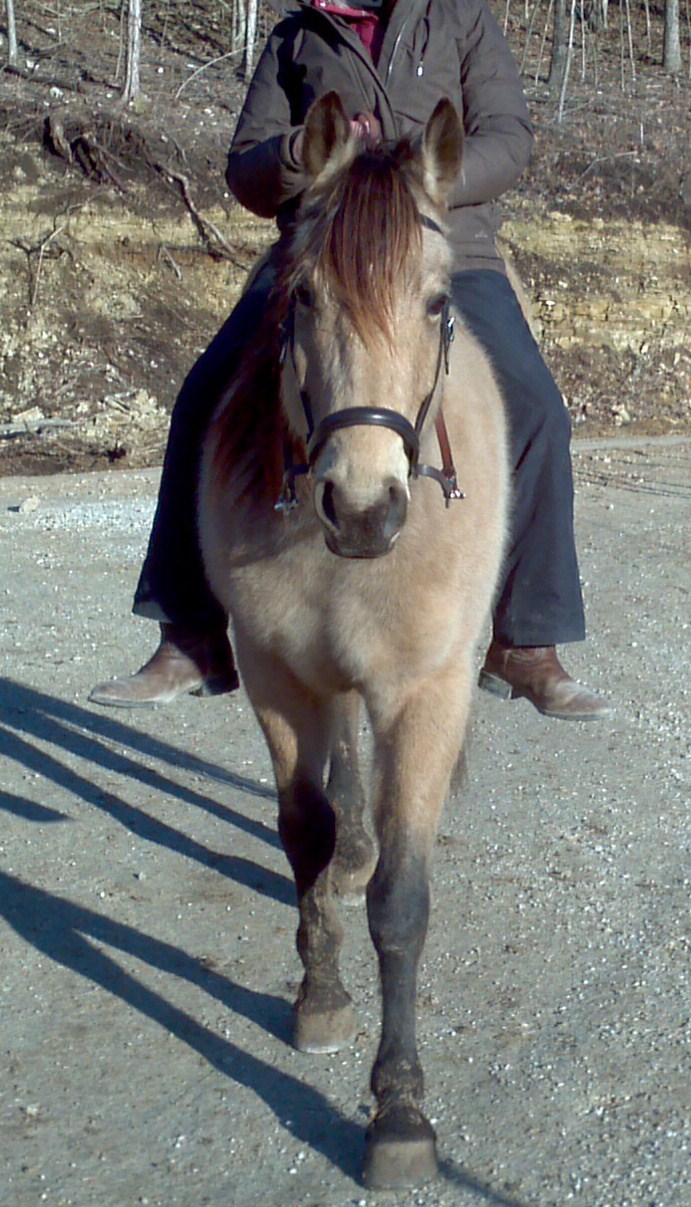
I had an interesting time the other day at the barn. I put the English saddle on Galahad, and a friend of mine tried lunging him with me on his back. No dice…. He didn’t want to move forward, and certainly wasn’t going to stay on the rail if he did (I had no reins at the time). Trot? Nah. Two or three steps, and he’d drop back to a walk.

Now, granted, my friend is not especially good at lunging or round penning, but you’d think that with my urging, too, he’d move out. Nope. He just does not like the saddle; not at all.

How do I know it’s the saddle? Because he’s happy to move forward with me on him bareback, happy to walk, eager to trot and (I suspect) gallop off, with me on board. We communicate well: he’ll side pass, “drift” or whatever it’s called, stop, back up, and do anything else I ask him to…as long as there’s no saddle involved.

Anyway, after trying for quite a while, I gave up, asked for my reins back, and “pushed him through it” to get several laps in each direction and the usual stop, back up, yield hind end. But he wasn’t happy about it, and I wasn’t happy forcing the issue.

Here’s my dilemma: How does “pushing him through it” fit in with the Carolyn Resnick philosophy that I want to be using with him? I’d say, not at all. Resnick’s idea is that you don’t force the horse to do anything. At any point, she says, the horse can choose to refuse to do what you’re asking; he retains control over his own actions.

“What?” you ask. “I thought you just said that the horse gets to express an opinion, but YOU decide!”

That’s right: it’s about leadership. Remember, a true leader in the relational sense gains the confidence and trust of her followers, to the point where they will do what she asks willingly and happily. Carolyn Resnick adds the “training” element, too: If you work with the horse, and make your request at a time when the horse is likely to do it (and not when he is NOT likely to do it), “obedience” will become a habit.

I’ve been puzzling over this for a long time now. I’ve been trained in several different methods of natural horsemanship. My first trainer was a fan of Dennis Reis; I’ve learned bits from followers of Parelli and Clinton Anderson. Currently, I study with Jay, who combines the best of all the major training methods, and whose style is near-perfect for preparing the Rescue Ranch’s horses for their new lives.

None of these methods are exactly what I want with my own horses, but Carolyn Resnick’s method (and that of Robin Gates, her student) comes extremely close. But here’s the problem: How do I know, in the moment, if what I’m doing with Galahad or Nevada is “right” in this new style that I want to embrace? For sure, “pushing him through it” is NOT.

After the Waltz Party last night, something came into focus that’s been there all along. The image, the metaphor I’m looking for, is the dance. I’m a very good dancer (according to my partners, at least), and it’s an activity that I find soul-stirring and joyful with a good partner. It can be excruciating with a bad partner.

Following a good lead through complex waltz moves is not something I have to think about: My body feels the music and interprets my partner’s suggestions without thought. It just happens, and it’s beautiful.

So why are some partners more desirable to me than others? What makes a dance, specifically a waltz, enjoyable to me? What is it that makes me want to go to the dances? I can tell you, it’s NOT the idea of having someone pushing me around all the time, music or no music.

I realized that Galahad and I are alike, in that we’re both excellent at following a lead that makes sense to us and that works with our body’s natural movements. We dance best with a partner who that doesn’t poke or prod or push us around. And I for darn sure wouldn’t want to dance with a partner who “pushed me through” the waltz!

So I’m going to stop trying with the saddle for a while. I’m going to invite my horse to dance with me, and let him agree, or not. Then I’m going to use subtle cues and allow him to respond, or not. I’m going to do my best to be that perfect dance partner that makes interaction not just fun but exhilarating. That does NOT include “pushing him through it” when he declines the dance!

Later on, when we’re both loving the dance and we have our cues adjusted, I can reintroduce the saddle. By then, he’ll be willing to trust my leadership, and we can continue our partnership in a slightly different way.

So that metaphor will be my guiding principle. If I wouldn’t like to be treated in a certain way by my dance partner, I’m not going to treat Galahad that way.

[Disclaimer: Please note that I am not suggesting that anyone try this for themselves without guidance, and certainly not unless they’re quite proficient at handling horses. I’m willing to take these risks, but I am NOT suggesting that YOU do it.]

More on Leadership and Relational Horsemanship

One day last month Galahad and I were walking by the barn. There was lots of commotion going on: They are putting a roof on the small arena, and things are a bit torn up. That day, the red arena gate was leaning against the hitching post, and there  was a black trash bag underneath it.

Well, Galahad took exception to the changes. As we got close, he pranced, he snorted, he danced and squirmed. His eyes got as big as saucers, and he made it known that this was NOT RIGHT. But interestingly, he never once pulled on the lead rope.

I pretty much ignored his reaction. We kept moving, and along the way I asked him to yield front and hind and back up for me. After that first pass, we made another, and another, and another, until finally he walked by the red gate without reacting.

Then he got curious, and on the next pass I let him stop and look at it. He jumped when I rattled that plastic bag, but quickly touched his nose to it to be sure it really was a plastic bag, not something deadly. Then he sighed and started asking to graze.

So: leadership. After I posted the entry about Dugan, Jay asked me to clarify a couple of things about relational horsemanship. He was concerned that some folks might misunderstand and think I was suggesting that relational horsemanship was all about the horse’s feelings, and letting him express them. Nope. If you do that, you’re apt to get hurt; if not that day, then sooner or later, because the horse is going to take advantage of you.

Relational horsemanship is actually about leadership more than anything else. Leadership, the way I practice it, is NOT about bossing people (or horses) around. Rather, true leadership is the art of getting your followers, or your horse, to cooperate and follow your lead willingly and enthusiastically because they trust you and want to do it.

I posted recently about the qualities of leadership that I find most important here. One of these seems to me particularly important in the episode of Galahad and the Gate. That is the fact that in true leadership (that is, in Relational Horsemanship), the follower is permitted, even expected, to have his or her own opinions. Galahad definitely had an opinion, and he expressed it; but he expressed it respectfully. As a leader, I considered his opinion, but I made the decision. And because he trusts me, because I am his leader, he did what I asked.

My issue with the way I handled Dugan is not that I didn’t lead, but that I led without consideration. I ordered Dugan to obey, rather than asking him to cooperate. It is quite true that Dugan might well have refused, and at that point, as the leader, I would have needed to insist on his cooperation–obedience, if you will. But relational horsemanship, and (IMO) good leadership, requires that we give our partner time to respond willingly.

Of course there are times when an emergency arises and we have to demand instant obedience. That’s part of leadership, too. But if we’ve taken the time to build a relationship of trust, our followers (horse OR human) will respond appropriately and immediately in that moment because they do trust us and accept our leadership.

One more thought on leadership: A leader always has to have a plan, or at least, she has to be able to act like she does. If a leader shows indecision, trust evaporates.

I was surprised when Galahad spooked at that red gate, because it didn’t look scary to me. But I had a plan–the same one that Jay taught me and that I use every time something like this happens. Keep his feet moving, keep going, and pretend the scary object doesn’t exist. And that’s what I did. Galahad didn’t doubt my leadership–he never tried to get away from me. He never pulled on that lead rope. All he did was express his fear, but because I didn’t acknowledge it as necessary (in fact, I ignored it), he soon calmed down.

(One of these days, maybe, I’ll be as good as Jay is: Galahad will come to believe that those scary things actually do not exist! We’re not quite there yet, but we’re on our way.)

Once Galahad’s fear was out of the way, his natural curiousity resurfaced. Only then did he get to investigate, and that, plus the grass, was his reward for trusting me.

Pita and the Mean Little Black Horse

A friend and I went by the barn late yesterday afternoon to give Galahad and Nevada a bit of grazing time and to feed Midnight his third meal of the day. It was already pretty dark by the time we got there—a lovely, chilly evening. We were standing around in the yard near the barn, listening to the munching and crunching.

Pita the Barn Dog—a half-grown Border Collie pup—was playing like she usually does, picking up whatever comes her way and tearing around with it, growling like mad. First it was an empty plastic milk jug, then a piece of hoof left by the trimmer. We and the horses pretty much ignored her as it got darker and darker.

Suddenly, both horses spooked. A small, bright light was zipping here and there across the lawn! The horses snorted as it got closer and closer…but relaxed when we all realized it was Pita, carrying…a cell phone. Fortunately, Pita understands “drop it!” pretty well, and we were able to rescue it and return the phone to its owner, who had been down in the pasture with a flashlight looking for it.

After putting Galahad and Nevada back, I got Midnight’s evening meal ready: beet pulp and senior feed soaked in hot water. He loves it!

Of course, Pita went with me to call Midders, who whinnied and came running across the pasture. Meanwhile, Pita trotted along across the bridge over the creek, carrying something else that required a lot of growling to keep it in line. Even her light weight made the boards on the bridge rattle, too.

Midnight, who was on his way to cross the creek, saw a small, dark shape moving across the bridge, making all kinds of ugly noises: Clearly, this was the proverbial horse-eating monster. Then it crashed into the brush, obviously on its way to eat him for dinner.

So Midnight took off at a gallop.

Meanwhile, Pita who had apparently misjudged the distance from the bridge deck to the brushy ground beneath it on the other side of the creek, picked herself up, shook herself off, and was about to continue her romp when…

…Midnight discovered what it was making the noise. Well, Midders has a temper. And he hates to be fooled. So he put his head down and charged after the dog.

Pita, shocked, ran for her life, with little Midnight galloping right at her heels. They splashed across the creek, Midnight’s teeth two feet from the pup’s behind. Pita flew up the bank and just kept going. Midnight skidded to a stop inches from the gate, snorting and blowing his irritation. That was the last we saw of Pita that night.

That wasn’t the end of our evening’s adventures, though. As Midders was enjoying his dinner, my friend and I decided to put his lightweight blanket on, so I went to find it. Just as I got within ten feet of him on the way back, he finished eating and decided to have some fun.

Of course, I hadn’t put a halter on him—I never do, because his priority these days is always FOOD. When he finishes, I just put a lead rope around his neck to put him back out. Tonight, the blanket foray threw my timing off, and he saw his chance. Off he trotted, in that purposeful way of his.

Finding a black horse on a pitch-black night isn’t the easiest thing, especially with eyesight as bad as mine. I can still hear, and followed his movements by sound. Occasionally I caught a glimpse of his white star when he turned around to look at me. He wouldn’t come to me, though. Oh no! He had adventure in mind.

When he headed for the barn, I thought I had him: He’d just go into a stall. Nope. He walked right on through and out the other side. Fortunately for me, his stomach got the better of him, and he made a tactical error: He turned to check where the round bale used to be, and I was able to cut him off.

Needless to say, he wasn’t pleased at being caught, and he made that clear as we put the blanket on him—threatening to nip, trying to move away, and all the other games he plays. But he went quietly enough, in the end. I think we all enjoyed the romp.

Blessings from the horses

ImageAs I was putting together an article for a local newspaper on the one-year anniversary of the Ranch’s internship program, I asked the group to tell me what the program has done for them, with a focus on the benefit to our horses. What is it that keeps them coming back?  Is it preparing the horses for their new homes, getting them over their fears, seeing them adopted?

They all agreed that these are important factors that keep them engaged in the often-difficult task of learning relational horsemanship. They are all happy to have a chance to contribute to the horses’ wellbeing. But what surprised me was that every one of them mentioned the effect of this training on their own self-confidence! They have all experienced a positive effect in their own lives and relationships.

Now, I know from my work with clients that horses often have this kind of transformational effect on people, and I hoped that some of our students would experience it, too. What a wonderful surprise to discover that every single one of those who responded had noticed the positive changes!

That’s a powerful affirmation of the work we’re doing: not just changing the world for the Ranch’s horses, but changing the world for all of us. I’m grateful to be a part of that.

A new stage in our relationship

A few months back, a friend of mine introduced me to the work of Robin Gates. Robin is a certified trainer in the Carolyn Resnick method, and the videos on the two sites are amazing. THIS is the kind of relationship I want with my horses!

Actually, the horses and I already have already begun to develop the kind of mutual trust and affection that the Resnick method produces. After all, it’s not like there’s one and only one way to do anything in this world. But what I like about it is that it gives a series of steps, a method, that seems likely to expedite the process.

Carolyn’s  DVD describes the basics of what she calls the “Waterhole Rituals,” which are the foundation of the work. I’ve decided to begin working on those with all three horses. Over the next few months, I’ll report on our progress.

At the moment, Galahad and I are doing “sharing space”: just hanging out together. It’s something I knew would be helpful even before getting the book. Galahad and I are doing it a little bit differently, though: Because our small arena is being roofed and the main arena is rather large and muddy, we’re working right out in the big pasture with the rest of the herd. I’ve been sitting out there on a small stool, reading or watching or meditating, just BEING THERE with him.

While I’m sitting there, he comes over once in a while to check on me, hangs out for a minute or two, then wanders off. No treats involved here, either—I don’t want him (or the others!) nosing me just to get carrots or cookies. This “join-up” needs to be completely voluntary on Galahad’s part—that’s the point.

This work will demonstrate the strength of our relationship, and let me watch it change over the course of days or weeks. I believe it will deepen our bond, and I’m hoping to get to know him even better, not just as a riding companion but as a himself, an autonomous being with his own personality, desires, and needs.

It’s been fun to watch how he interacts with his herdmates and find out who the herd leaders really are, what the sub-groups are, and what the horses do during the day. It’s very calming for me, and that in itself is a blessing!

I’ll share our experiences with you here, and we may want to incorporate some of these activities in the work I do with you, my clients.

A lesson in the meaning of relational horsemanship….

The other day at the Ranch a couple of women, both of them riding instructors at a local, private barn, came to look at a pony for their lesson string. They only allow their ponies and horses to be ridden a couple of times a day, so it’s not like a major public boarding barn where the poor lesson horses do lessons and trail rides all day long. The Ranch is very particular about where we allow our horses to find their new homes.

I had been doing paperwork and was walking across the aisle to the office when Jay hollered, “You want to ride Dugan?” The riding instructors were looking at “Dugan,” a pretty little Connemara pony who is as stubborn as the day is long.

I was caught completely by surprise. “Sure,” I yelled back reflexively, and immediately started quaking in my boots.

I’ve ridden Dugan before—he and I actually got along pretty well. He’s smart and well trained and, once he’s convinced you will follow through on your requests, is a fun little guy. It wasn’t that I was afraid to ride him. I was afraid to ride him with an audience. And of course there’s the general fear I still have of getting on a horse, the one that goes away once I’m in the saddle.

The instructors had already saddled him up and were in the process of putting on his bridle when I got to the arena with my helmet. I suggested they take the bridle off because I wanted to move him around some before I got on him. They looked at me blankly. Dugan hasn’t been ridden much in the past few months, and I haven’t ridden him in over a year, so I sure as heck wasn’t going to hop on without checking out his mood first.

They didn’t want to take the bridle off. “Just hook the lead rope to the bit,” the instructor said. “He’ll be fine.” But when it became obvious that I wasn’t going to do that, she said, “Well, just put the halter on over the bridle, then.”

So I did. I probably should have spoken up and had them take the bridle off, but I didn’t. I was too cowed.

I walked Dugan out into the arena and put him through his paces. I moved his front end, I moved his hind end, I got him to trot around me in a circle, I had him do lateral work against the wall at a pretty good clip. I did everything that one would expect—all the things I’ve been taught. But even in the moment, I knew something was all wrong.

The thing is, I feel sorry for Dugan. While the techniques I used may have been correct, the intention behind them was not. I was doing “natural horsemanship,” but this was not relational horsemanship by any stretch of the imagination.

Replaying that interaction in my mind’s eye, I cringe. Going in, my preconceived idea was that this was a stubborn little pony who needed to mind. I was rough with him, I was abrupt with him. I didn’t give him a chance to respond to me. I didn’t give him time to actually do willingly what I was asking him to do: I made him do it. My mindset was to make the horse do it, to make him obey.

In that moment I turned into Arthur, my father, and that’s not something I’m proud of. I wasn’t able in the moment to get out of my own head. A true relational horsewoman would have focused not on the actions but on the relationship, on that sense of partnership with the horse, and I was not able to do that.

Shame on me. I got the job done, but it wasn’t pretty. And more than that, it wasn’t right. It didn’t do justice to that little horse, who deserves better.

In my defense, I did have not one but two riding instructors who thought I was nuts, and “God himself” in the form of my mentor Jay, watching. Still, I wish I had been able to stop worrying about being judged. That makes me really sad.

My apologies to Dugan. Hopefully, the next time I’ll be able to do a better job. I guess the first step in changing something is becoming aware of it. Well, I’m now aware, and embarrassed, and determined to do things differently.

Head versus Gut, Part Two, or, The Cell Phone Returns from the Dead

This little story isn’t one that I’d ordinarily put on this blog—no horses in it. It’s more appropriate for “It’s an Alchemical Life.” But it follows so well with the post about Nevada and her jaw that it seems to want to be here. So here you are: The Universe reinforcing my growing trust in my intuitive knowings.

Yesterday I was crawling around on the rocks next to my backyard waterfall when my cell phone went for a swim. I fished it out within seconds of its dunking; nevertheless, it was lifeless and still. No pretty green light or tinking bell, no comforting buzz…nothing. I took it apart, dried it off carefully, but still…nothing. Deader than dead.

Now, here’s the really intriguing thing: At the moment the phone took its dive, someone or something inside me said, “Well, dang. That’s inconvenient. But it’ll be fine.” My body said, “It’ll be fine.” No feeling of terror, no sense of dread—nothing. “It’ll be fine.”

But did I believe that? Nope.

Instead, I took to my bed (sad to say, quite literally) and the Drama Queen took over. Tears, wailing, gnashing of teeth ensued: “Why did this happen to me? What can it mean? Those phones are expensive—where will I get the money to replace it? I’ll miss all my important calls! I can’t go anywhere because I might get mugged and have no phone to call for help! What if I die!” Ms. D.Q. has a great imagination and good vocal chords.

A while later I got up again and went to the Ultimate Guide to Life: facebook. My friends had words of comfort and advice, almost all of which revolved around rice and patience. Especially the patience part; not my strong suit.

Three whole hours passed, and the cell phone was still dead. Five hours. Ten hours…twelve. Finally, around midnight, I gave up and went to bed, feeling vaguely betrayed (“You said it would be fine! You promised!“) and quite depressed.

This morning, mirabile dictu, my phone has returned to life, evidently unscathed by its visit to the Other Side. What’s most intriguing is my response: I detected a touch of disappointment in that fact! Wow! The Drama Queen was actually disappointed to find out that she has nothing to tear her hair over. Wow….

So: My intuition was correct once again. I felt that the phone would be just fine, when I listened to my body and not to my head. I felt that way even last night when it still looked to be dead, and even while wailing and moaning about being “wrong,” and “how can I ever learn to trust my intuition when I’m wrong about something like this,” and on and on…and lo and behold, the phone is JUST FINE this morning.

Here’s the Big Question: If I were to change my belief about being in the world, what would happen? What if, instead of “if you want it you can’t have it” (which is what I learned ever so well as a child), the refrain said, “If you want it and work to make it happen, very likely you can have it!” (Yes, even that statement is cautious, but hey—baby steps!)

It’s amazing: First, how difficult that change in belief pattern feels to me, and second, how vastly different my life might be—would be!—if I were to change it. My entire world would change.

My entire world will change. I’m learning to trust, even after sixty years and more.

The Drama Queen is sitting over there in the corner pouting. Get used to it, honey.

Addendum: A friend, reading this, points out that clearly I have not yet put Ms. D.Q.’s crown on Craig’s list. I have to plead guilty to that one. But it’s so pretty….


Head versus Gut

The horses are at it again, teaching me about life skills. Their latest lesson is about intuition.

It has been so interesting over the last few months, watching the battle that goes on in my head between what my intuition (expressed by my body and my gut) tells me and what my head tells me. And “battle” is the correct word, because no matter how strongly my intuition says not to worry, my head goes on spinning tales of woe and danger. And that’s despite the fact that I know, even with my head, that it’s my body that is tuned in to Guidance

Here’s just the latest example:

This past week I had quite a scare with my little mare Nevada. Because of some other commitments, six days elapsed between my visits to the barn. In that six days, Nevada developed a walnut-sized, bony growth on her lower jaw. Bone growing that fast and in such an unexpected location did not seem to bode well.

OK. So the facts were pretty scary. But I knew with my body that she was fine, or at least that whatever the growth was would not be a problem at all. I knew this. There was no tension: My heart rate didn’t go up, my stomach was relaxed, my gut was at ease. There was no sense of impending disaster—at least physically.

And all of that intuitive information was confirmed by the horses: Nevada herself insisted she was fine. And “R.C.,” our local “wise old horse” (even wiser, in some ways, than Midnight) chimed in. In his terse, old-man way, he said, “She’s fine,” and just shrugged me off—literally turned his head away—when I asked for clarification. R.C. is a horse of few words, who has little patience with panicky humans.

Despite all of that evidence, and despite the strength of that evidence, I continued to fret about how on earth I was going to pay for the expensive operations and radiation—yes, radiation treatments—that Nevada was certainly going to need. And how would I ever get her to Columbia to the vet school? Would she survive? Would I have to make the terrible decision to put her down? And on and on I went, not eating, not sleeping….

The whole time, the Witness part of me was just watching this play out, shaking its head, amazed and a bit sad to see how I was winding myself up over nothing while busily not listening to the quiet voice of wisdom that my body was providing.

This was quite a lesson for me. The vet’s diagnosis, two days later—a problem with teething that would resolve itself on its own within a month or so with no further treatment at all—was so anticlimactic that I cried and laughed at the same time. Wow. All that drama for absolutely nothing—and the entire time, my body, my intuition, knew that it was absolutely nothing, but I refused to listen.

This is just the latest in a series of such incidents, but this one was HUGE because of just how enormous the gap was between my imaginings and reality. As usual in life, the “lessons” (the Guides object to me calling them “lessons”) just get bigger and bigger until I finally get it.

I think I’ve finally gotten it this time. I’m going to go with intuition from now on. Yes, being prepared is a good idea, but worrying myself to the brink of insanity is most definitely not.

I’m going to hang up my Drama Queen crown. Maybe I’ll even put it on Craig’s List.

Who says horses can’t talk?

When I first got involved with horses a few years back, I remember thinking, “Gosh! How will I ever know what they’re thinking? They have no expression!”

Seriously?

Now I marvel daily at just how expressive they are–I just had no idea, back then, how to read the nuances of the wrinkles above their eyes, the pucker of their mouth or chin, the angle of their head.

And they communicate so clearly, once you learn to read them! Here’s a case in point:

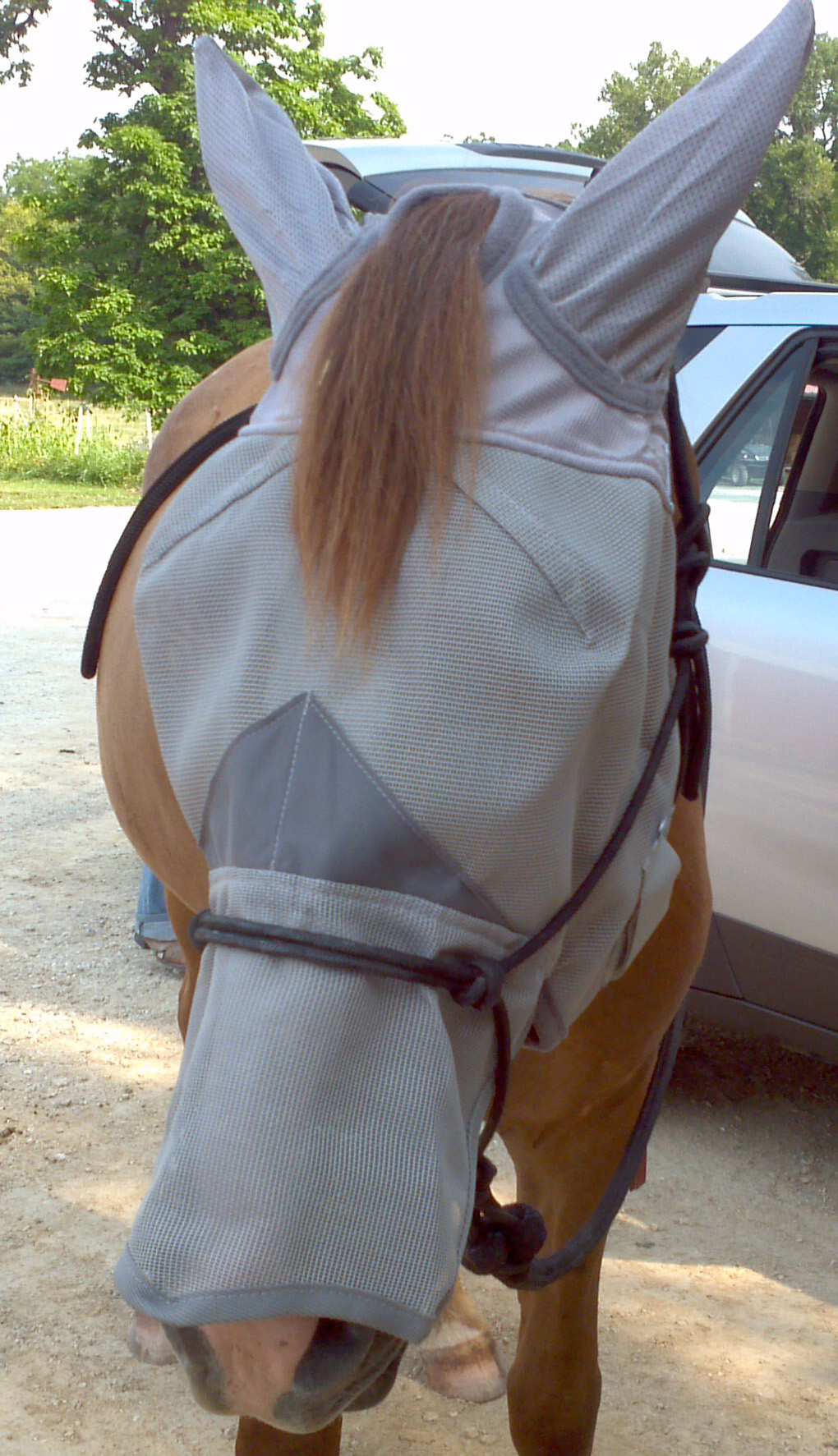
We’ve had a dreadful fly season already this year, and the horses have been pretty miserable. Fly spray seems to be more of a condiment than a repellant for the little menaces. Several of the horses are wearing fly masks 24/7 by now. I didn’t have them for any of my guys.

The other day I went to the pasture to get Nevada, who normally whinnies and moves right over to meet me. This morning, she didn’t come, though she saw me right away. She was standing with one of her girlfriends about halfway down the fence line toward the woods, and there the two of them stayed.

I walked over, wondering for a moment if there was something wrong. But no, both horses were just fine. Nevada, though, had something on her mind.

She looked at me, then pointed her nose at her friend’s fly mask, then looked at me again; she made that same gesture three times, just in case I missed her message the first time. “I want one of those.” She could not have been more clear about it.

So, of course, I went and bought her one. She’s never had a fly mask on in her life, but as soon as I showed it to her, she stuck her head right in, ears and all, and gave a big sigh of relief.

So who says horses can’t talk?

Not just a hoof clinic….

Yesterday I had the great good fortune to attend a beginner hoof trimming clinic with Ida Hammer at her place in central Illinois. I don’ t want to become a trimmer (certainly not starting out at 60+!), but I do want to know everything I can about my horses’ feet and the care they need. So a friend and I made the 4-hour trip.

The clinic was amazing, and not just because of the information. It was such an experience, on so many levels!

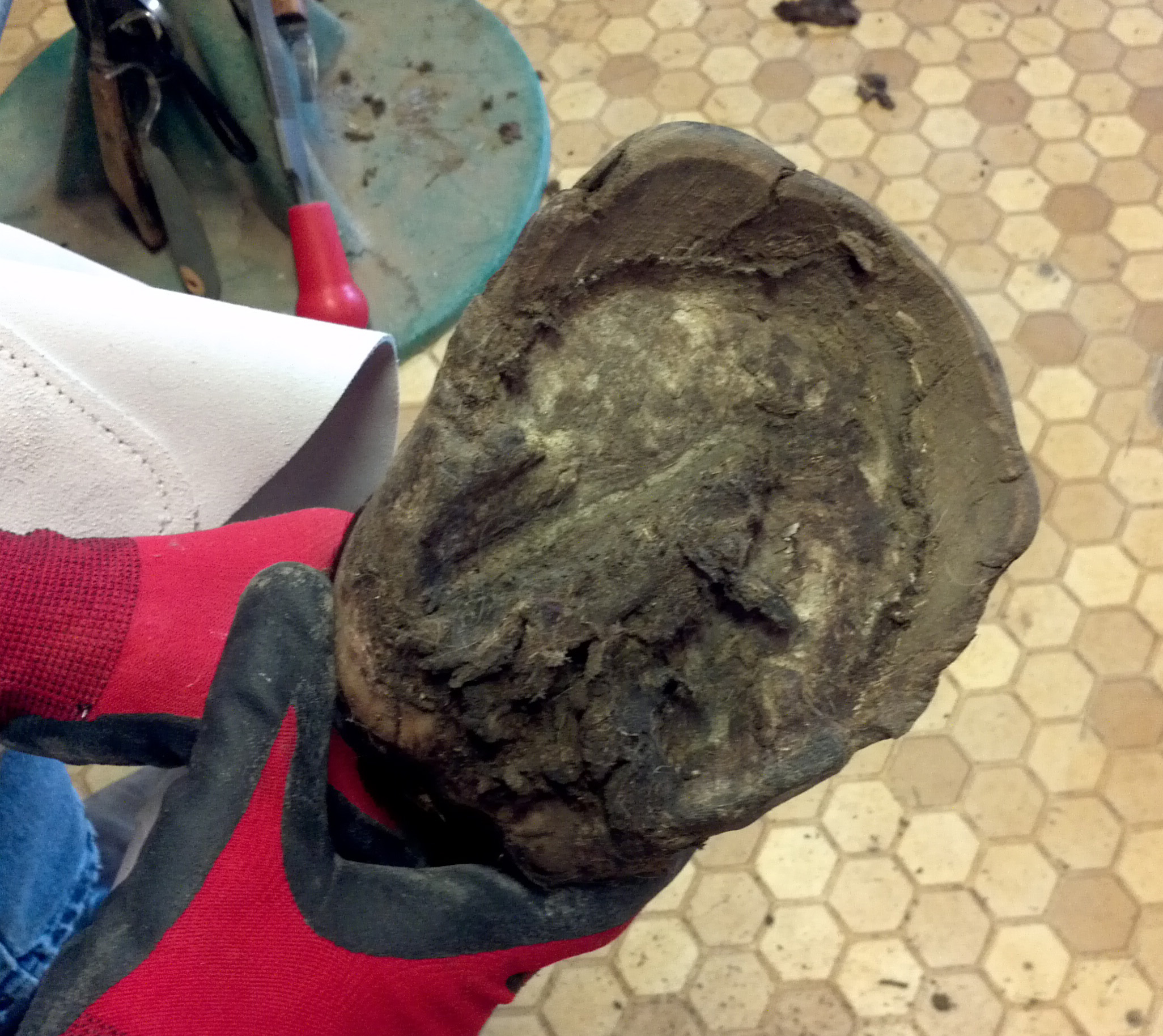
I had been afraid that it would smell bad and I’d be uncomfortable. Well, it didn’t exactly smell great, but there was no smell of death—the legs were fresh-frozen and then thawed, carefully wrapped with plastic and duct tape to expose only the fetlock and hoof. Those were some gnarly, smelly feet, I’ll grant you. Hooves of all shapes and sizes, in pretty bad condition.

The sheer amount of information that was shared was astonishing and overwhelming at times. Ida’s knowledge is deep and broad, and her enthusiasm and love for the horse is huge. The most important thing I learned was how much I still have to learn—a lifetime isn’t enough!

What was most interesting of all, though, was the “relationship”that I developed over the course of the day with the big horse whose foot I trimmed. There’s no explaining it in logical terms, other than to say it was my imagination running away with me—but I know that wasn’t the case. From the moment I first picked it up, that leg felt alive to me, not in a physical way, but energetically, psychically. That horse was PRESENT. His energy was big, warm, curious, friendly, happy. He was not in the least distressed by what was going on.

As the day went on and the trim proceeded, I found myself talking to him, patting him, reassuring him, like I would have done to a living horse. I was careful to put the leg down gently, and to protect it from people walking past. Doing a good job with the trim was important to me so he could walk properly and freely—even though this leg, obviously, would never again feel the ground in a joyful gallop. No matter.

Call me crazy, but that experience was as intimate as anything I’ve had with my own living, breathing horses. By the time I had that hoof trimmed up and looking great, I felt like he was “my” horse—felt so much affection for him and happiness in his presence! The thought of him running across those heavenly pastures with beautiful, sound feet was a joy.

When it was over and Ida asked who was going to take their leg home, I wanted to raise my hand. But we were several hours from home without a way to keep it chilled overnight and on the trip back.

What, you ask, would I have done with an amputated horse leg? Buried it in our little pet graveyard out in back of the house, with Shadow and Oshie and Wendy the Dog—those other four-legged family members who’ve gone on ahead.

But instead, I’ll write, and honor his memory and his sacrifice this way.

I wasn’t the only one to sense the presence of the horses yesterday. My friend, auditing, says she could feel the entire “herd” there with us, happily grazing and watching us as we learned from their feet and legs, just hanging out with us. Horses, in life and death, are amazing creatures.

Last night, lying in bed at the hotel, I missed my new-found friend and grieved his passing as if I had known him a long time. Those tears felt right and just. This morning, the intensity of the sadness has moved on and I’ve gone “back to grazing.” His memory, and my gratitude, remain.

Many thanks, my four-legged friend! And if you didn’t know love and care in your lifetime, I hope you could feel it yesterday. Godspeed!