Measures of Learning

20141204154411 (2)It was an interesting day at the barn yesterday. Foggy, misty, cool but not really cold. When I arrived, the horses were grazing peacefully in the east pasture. Galahad followed me back to the fence, where I put on his halter and tied him so he’d stand still for me to treat his rain rot with iodine. Sometimes he gets bored and wants to wander off.

The peace and quiet didn’t last long. I had gotten maybe six square inches of that big, broad back treated when things got going.

It started with the mares in the other pasture. SOMETHING BAD, they said, was on the trail. Their intensity got the geldings’ attention, including Galahad’s. I couldn’t see a thing. The rest of the geldings were tense, snorting and dancing, not really sure what was wrong.

As everyone’s energy mounted, Galahad started to prance and snort, and I could feel my fear rising—an old reaction that I haven’t felt in a while. If he hadn’t been on the lead rope, I’d simply have moved him off to a safe distance. As it was, my mind called up the old image of a Raging Creature on a String. What to do?

First thing I did was take a breath and feel into the fear. Yes, I really did have the presence of mind to become conscious of it, and to understand that although I was afraid, I do now have the tools and training to handle the situation.

I’m quite proud of that split-second awareness! Guess I’ve learned something over these last few years!

The next thing I did was to untie the rope from the fence. Then I waited to see what would happen. Didn’t have to wait long. He reared and tossed his head. I bumped the lead rope, surprisingly calmly, and he dropped back down. Then I backed him about 25 or 30 feet, asked him to circle me on the line a time or two in each direction, then backed him some more. He did it all with a lot of energy, but no resistance.

Then I walked over and took the halter off, expecting him to whirl and run.

He didn’t. He stayed facing me, paying attention to ME and not to his herd mates, who were still milling excitedly around near the mares. In fact, I was able to back him up, circle him a bit more, move his hind end, and get him to change directions, all at liberty.

Then I sent him off to be with the herd. Pretty amazing.

In general, I think I did OK. My first thought was to control him—back to the natural horsemanship techniques that are (thankfully, sometimes) second nature by now. Control is probably not a bad thing to think about, considering that he’s 1100+ pounds of muscle, bone, and hoof. And goodness knows how tall he is when he’s standing on his hind legs! There was also the fact that he was not at liberty—I couldn’t readily send him off—and I needed to have him calm enough to get his halter off safely.

The unexpected and delightful part of this experience is twofold: First, he never actually tried to get away. His rearing was just a statement of what he’d LIKE to do. He wasn’t threatening me, and had he wanted to get away, he most certainly could have. I wouldn’t have tried to stop him.

Second, he trusted me way more than I trusted myself in this situation. Galahad did what I asked, even though the other horses were agitated and moving around. He chose me over his herd. I know that, because he did not leave me after I took his halter off, until I asked him to go.

Wow….

How interesting. Hopefully, next time I’ll remember all this, and not need to be afraid. My horse trusts me. That is amazing.

“Galahad and the Beanstalk”

for galahad and the beanstalkMost of us have had dreams that were so intense and amazing that the images stay with us for years. These dreams, as well as waking images and experiences that share that same haunting quality, are often referred to as “numinous” in the Jungian sense. Numinous experiences are ineffable, spiritual, impossible to describe. They evoke a sense of awe, mystery, importance, and, often, fear. I experienced a numinous dream this past summer:

When I dropped off to sleep this evening, the movie “Jane Eyre” was playing in the background—so it’s no surprise that the dreamscape is the English countryside. There’s a centuries-old barn, and my Galahad is stabled there. I am with him in his stall. I don’t see him, but he moves his shoulder nearer to me and I feel his breath on my face and hands as he breathes me in. Then I’m outside. I look up and see a vine hanging down. It’s got delicate, dark green leaves and tiny purple flowers—very beautiful. It’s just hanging from the sky, and as I follow it up with my eyes, it becomes clearer, and I can see that it goes up forever. I wonder if it will fall if I pull on it, but it doesn’t. Then I wonder if I can climb it—so I try, and the vine easily and naturally hugs my foot and leg to help me. I start to climb up, knowing I will be able to climb as high as I would like! Then I remember sweet Galahad and his warm physicality, and I hop down off the vine. Very strange—but lovely, warm., satisfying….

A few days later, I figured out why the dream felt so “familiar” to me—I remembered another hugely important dream from more than a decade ago, at a time when I was casting about for the next step in my life journey:

I am coming out, it seems, from “underground,” somewhere I’ve been with friends, perhaps a restaurant. I walk out into the edge of the woods along a road. My attention is caught by the early morning sun slanting through and illuminating the mist in shimmering patches rising from the ground. I move closer, spellbound. Each tiny hair on each fuzzy leaf is so clear, the drops of mist so sharp—I can see it all, feel it all. I am awestruck and I realize that I am one of the few who can see such things, or see that way. I look up and find myself at the base of a mighty tree—tall, so tall I can’t see the top, and huge. It is split into two huge trunks; lichens and other strange plants have taken root here and there. I can see it all with such clarity, and can feel the bark beneath my fingers. I look up and up, becoming more breathless and awestruck with each second. It occurs to me that I could climb that tree—all I have to do is scamper up it like a squirrel! I can actually feel my tiny claws gripping the bark as I go up a few feet, but I am afraid. Awe and yearning well up in me and I can’t move, only look and cry out to the Being I call Grandmother for help: “What does this mean?” I wake slowly, reluctant to let the vision go.

These two dreams seem to mark stages in my understanding of my Soul’s path in this lifetime. The “Tree of Life” dream is the most powerful and numinous that I have ever had. At the time, it helped me to begin to realize both the fear-filled paralysis I was suffering as I tried to figure out what to do with my life after a layoff from my career as a research botanist. It also brought to my attention the gifts I have been granted, as one who can move relatively freely between the imaginal and the waking worlds. In the “Galahad and the Beanstalk” dream, the dream-I is curious about the beautiful celestial vine, and I begin to climb it without fear—I know that “I will be able to climb as far as I would like!” As in the first dream, though, I stop before going very far. But this time is very different: I stop not from fear but from love of my horse, and a deep knowledge that my path lies not in “heaven” (in my personal symbology, heaven represents the refined, spiritual, “mental” plane) but in the world, in connection with Nature and Horse. My path leads not upward toward Spirit and Samadhi, but downward and inward toward the deeper, embodied, feminine knowing of Soul. In the months since the “beanstalk” dream, I have become more certain of its message, and of the rightness of the direction it suggests. My soul craves not the denial of or escape from my embodied state, but the full embrace of embodiment, of deep connection with the Earth and all her creatures. This sense hints at a darker, moister, more “feminine” path; and yet it is not “passive and receptive,” as the Feminine is so often defined. But what might this mean? Exploration of the Feminine (in Jung’s sense) through interaction with my horses feels right to me: My interaction with them, and the community I’ve found since beginning my work with them, calls to the depths of my being. So even though I still can’t see more than a step or two ahead, I will trust and follow where my soul leads! Cross-posted on It’s an Alchemical Life.

Summertime

2014-06-03_17-41-12_601Summer weather here in Missouri is definitely not a favorite of mine. I do not function much at all when the temperature and humidity are up, so not much “training” gets done. That is, if you’re looking for training as in “directed activity outside the pasture.”

Feeding, sometimes, gets done outside the pasture, but mostly not. Walking around outside the pasture sometimes happens, but not often. There are too many days where I do a “drive-by” feeding: mix the food ahead of time and run by the barn to deliver it to each horse, along with a dose of fly spray and a quick check of each one’s physical condition.

The only other interactions are sitting around watching the horses, walking slowly around the pasture with the herd, or standing next to Galahad while he naps. This is his favorite summertime activity other than eating. Sometimes he will pester me into standing still and letting him nap with his head on me.

Yesterday it was miserably hot—mid-90s with the dew point in the 70s. The trimmer came to check Galahad’s hoof (he developed an abscess in his right front foot a couple of weeks ago), but we managed to find a shady spot to work in. Afterwards, in between bouts of grazing on a line, he came over and napped for a bit with his nose buried in my armpit.

Hmmm…. A curiously intimate moment, for sure, and strange from a human perspective. But it’s pretty heartwarming, too, given that the first thing he does when he goes back to the pasture after an absence of more than a few hours is to roll luxuriantly and get the good herd-smell back onto his body. My smell apparently is good and comforting to him.

Is this “training”? I think so: It’s relationship-building, for sure. And I’m happy that he’s developed that kind of trust and comfort in my presence.

The Benefits of “No”

Galahad is DONE (1)Galahad and I had a really great time the other day in the jump arena. It was a spur-of-the-moment thing—some ground poles were still in place from the jumping class, it was a relatively cool day, and there were no other appointments on my schedule.

I asked him to walk on a loose lead over the poles one at a time. That was scary, he said, but he could manage it.

I asked him to sidepass over one of them, but he declined; too scary. Now, this is a “trick” that this horse learned when he was three, so it wasn’t new to him, and he’s been in this arena many times before. I doubted that “scary” was his real reason (see below). He said he would paw at it. He would sidepass in front of it (so he could keep an eye on it, one supposes), but otherwise it was too scary.

Then I asked him to walk over a set of three poles arranged a few feet apart; he said that was WAY too scary. But he offered something else: What he could do, he said, was walk between them, up one way and back the other. This was entirely his idea, since I was still mentally focused on motion over them and wasn’t guiding him at all.

I love his creative “solutions.” It’s just one more example of his overall willingness and desire to work with me.

I didn’t press the issue—I just wanted him to have a good time. After a while I let him prance and dance off the lead, and gave him lots of treats. He went back to the pasture reluctantly; I love that he’d rather be with me than with his buddies (and no, it’s not just the treats!).

Some of my natural horsemanship friends are questioning me about “letting Galahad get away with” refusing a request. “That’s not how you do it. You need to apply increasing pressure until he does what you’re asking, then release!”

That’s the received wisdom, and it’s an effective way of training a horse. Clear communication with your horse, in that school of thought, includes communicating that there are unpleasant consequences for saying no. If that kind of training is done well, it produces a horse that quickly complies with whatever you ask. The horse trusts the handler, if it’s done well, because the communication is “fair” and there is no misunderstanding.

I’m good at those techniques. They resonate with me. I was raised that way by my dad, who insisted on instant obedience—or else. There was never any confusion in my mind about whether or not to obey because I didn’t dare to question him. There was always that “or else” hanging in the air between us, right up until the day he died.

Problem is, those techniques don’t lead to the kind of relationship I want with my horses. Sure, there are times that he must obey me, like when the vet or the trimmer comes to work on him. But for the most part, I want Galahad to be able to tell me what he likes and what he doesn’t like, and I want to be OK with that.

Liberty trainer Farah DeJohnette has a blog post on this subject—you can read it here. She explains the rationale very well and suggests some questions to ask when a horse says no:

I want horses to tell me No. I want them to tell me what they like and what they don’t like. I want to be able to accommodate their desires because I am going to request that they accommodate mine. If a horse is traumatized, the No is the best way to build that trust back up in humans.

These are the a few of the questions I ask when I see a “No” in a horse:

I ask myself, why is that No there?

Why did you feel like you had to say No?

Are you uncomfortable?

Are you afraid?

Are you Confused?

Are you unsure?

Are you used to being over pressured?

It may be none of the above. It could be simpler or more complex.

A lot of the time, I believe that Galahad refuses a task (especially when it’s something he’s been taught) because of the last reason she gives—pressure. In his early life, Galahad was pressured into performing. I know I’ve done that to him at times, especially in the beginning when I didn’t understand natural horsemanship very well. Galahad has never reacted well to pressure. He shuts down; even though he may perform the task, there’s “nobody home” behind those eyes.

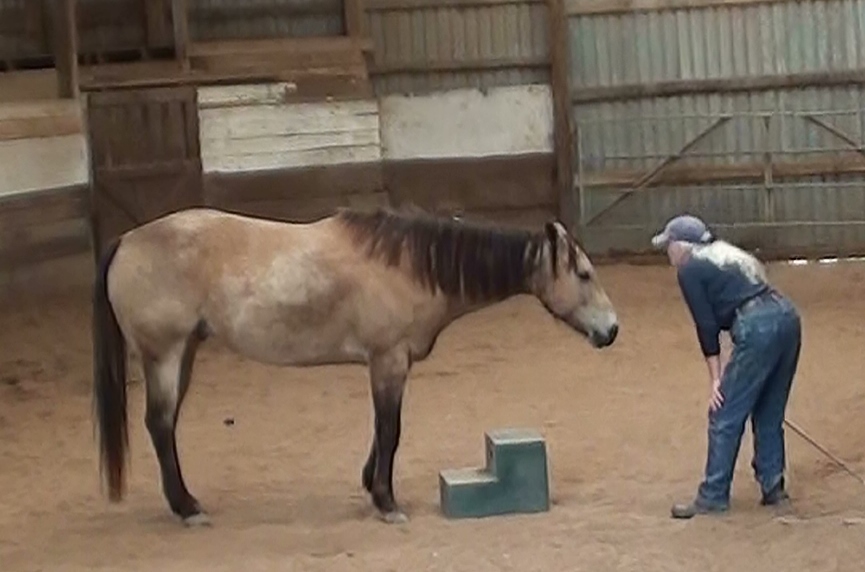
Here’s a little video clip that will show you exactly what I mean. I had been asking him to do some simple groundwork routines because I wanted to polish up his manners on the lead line, and I was using the standard natural horsemanship techniques. He did what I asked, but nothing more. Once I actually noticed his mental/emotional state (I’m kinda slow on the uptake sometimes), I thought I’d take off the halter and ask him to touch the mounting block with his foot. Usually, he enjoys that and will get pretty enthusiastic about it.

That day? Not so much. Take a look: He’s DONE. As a video, it’s kind of funny, but it gives you an idea of just what a horse that’s accustomed to too much pressure can look like. It’s taken me a year to get past this issue with Galahad—that afternoon was the first time I had seen him this way in a VERY long time, and I don’t want to see it again, ever.

At this stage in his training, I’m perfectly happy for him to say “no.” As we progress and his willingness increases, I’ll be able to make requests without him shutting down, because he will have come to trust me enough.

Meanwhile, I have an increasingly happy horse who loves my company and is happy to do more and more playful activities with me. That’s plenty for us to go on!

Long silence

Trail walkIt’s been nearly four months since I posted on either of my blogs. The reason, it seems, is that Midnight’s injury and long recovery took more out of me than I realized. A cold that started the day after Christmas kept lingering, and a bout with the flu in late January knocked me out for a couple of weeks. The cough lingered for most of February and triggered the pain in my tongue and jaw, which had been manageable up until then…. It got so bad that I went about six weeks in late February and March without a single full night’s sleep. That, friends, was NOT fun.

It felt like I “fell apart” right after Midnight’s condition improved to the point where we were no longer worried about his survival. I guess that at some level my body figured it was safe to let go the terrible focus and tension that had kept me pushing through that bitter winter, tending to him every day, and often twice or more each day. I’m no spring chicken, after all.

Anyway. It’s now nearly June and both I and Midnight are doing pretty darn well. Midders may never be quite as spry as he once was, but he’s loving his life! He’s able to walk, trot, and even canter when he feels like it, and he races the food wagon to his stall most days, twice a day. He’s always eager for a walk or a meal, and has gained weight despite the stress of these last few months.

As for me, I’m back to sleeping at night, worrying a whole lot less, and yes, I’m loving my life, too. I’m finally able to take clients again, and am looking forward to some exciting developments for the Alchemical Horse! Stay tuned!

This entry is just an explanation of this long silence, and a promise of posts to come on a much more regular basis. Thanks, readers, for checking in! I’ll talk with you soon!


(Cross-posted on It’s An Alchemical Life)

“Feel-Good” Moments

There have been so many wonderful, memorable incidents during Midnight’s adventure–too many to list in one post, for sure! Here’s one of my personal favorites:

Midnight and Galahad

Midnight and Galahad

When Midnight was first allowed to walk around the ranch, what he wanted most of all to do was see and converse with other horses. All up and down the lane, he stopped to check in with his neighbors.

He stopped for a long time near the pasture, across the fence from the hay bale where all the geldings hang out. It wasn’t long before the boys came over to say hi.

I was so touched by the greeting Midders had for his old friend Galahad. Here’s the video. This greeting went on for many minutes, and what was so surprising and memorable was Galahad’s response. My big boy is usually playful and boisterous, and a very lively game of bite-face (usually followed by run-and-chase) is his favorite pastime. But on this afternoon, with Midnight, he was so gentle and loving that my heart just melted.

It didn’t end there. I sent the video link to a friend of mine, who showed her 18-month-old daughter the video. The next day I received this email:

“Thanks for sharing. Midnight looks amazing! I was showing the video to Marcie because she loves horses. During the part where Midnight is kissing Galahad she leaned in and kissed the screen of my phone. Too cute!”

I totally agree.

The Inner Experience

2013-11-07_16-09-25_591Midnight’s injury and recovery has been a real challenge, but it’s also been a time of great personal growth. Throughout the process, I’ve experienced synchronicities and events that seem pretty clearly to reflect Guidance. These signs have kept me going when things got rough, and now, as we move into the rehabilitation phase of Midnight’s healing process and I have the luxury of time and a little distance, I can begin to examine them more closely.

If you’re interested, you can read more about my process and the inner work that I’m doing on my other blog, It’s an Alchemical Life, which deals not just with horses but with pretty much all aspects of my experience. I invite you to explore with me.

You can reach the blog from here or from the link on the banner above. Enjoy!

Focusing Energy for Healing

Midnight continues to improve. He’s doing so well that he’s now allowed to stay outside all day in the part of his paddock that we’ve fenced off for him. The other morning, when the door to his run was opened, he came out bucking—good boy, Midders!

Midnight has a huge, valiant heart. That optimistic little horse never gives up! He loves his life, he loves his people, and he enjoys every day that dawns. If ever there was a horse who could overcome a broken leg, Midnight is that horse.

I’m also certain that the prayers, positive thoughts, and healing energy that his huge circle of online friends sent him were instrumental in his remarkable recovery. There’s a specific and important way that I asked them for their help. It’s a concept that’s tough to put into words, but here’s my best shot:

Midnight’s owners and I, along with Dr. H. and a few others, knew the details of Midnight’s accident and his condition. Statistically speaking, a horse with a broken leg doesn’t have much chance of recovery. That’s “common knowledge…” but we were willing to give him a chance to beat the odds.

We all knew exactly what was going on with the little guy. But publicly, when asking for help, I always posted things in a positive way. I would say, “Midnight needs all of his friends to send positive, healing energy and prayers. And as you do that, here’s the image I’d like for you to focus on.” Then I would add pre-accident photos of him and say, “Visualize his whole, perfect, beautiful legs.”

There’s also the video (here) of him racing in for his dinner a couple of years back, demonstrating his wonderful energy and optimistic nature. Again, I’d ask people to focus on his beautiful, perfect self, and to notice his vitality. I never publicly mentioned the very real dangers of his condition, or the sores that developed halfway through the process.

Some folks have suggested that by doing it this way, I was denying reality or engaging in some kind of magical thinking. Not so. All of us dealing with him every day—and in fact, anyone who knows very much about horses—were keenly aware of the dangers of his condition and the statistically probable outcome. But that’s not where I wanted energy to focus.

Was it magical thinking? Was I just saying to myself, “If I want it badly enough and wish hard enough, then surely it will happen just this way!” No. Denying the existing situation, or refusing to see and acknowledge the range of possible outcomes would be delusional.

So how does this differ?

It’s not a question of denying any possible outcome. Rather, I simply wanted to focus on the possibility of healing and on the outcome that we wanted to have happen. I did NOT say, “Oh, he’s doing great and there’s nothing wrong with his leg.”

More and more people are beginning to understand that we create our own reality, and that where we put our energy and our thoughts is vitally important in the way our lives unfold. Personally, I’ve come to this understanding over the past couple of decades and have seen the truth of it in my own life. It’s a huge and difficult topic, and throughout recorded history, greater minds than mine have written extensively about this fact of existence. One recent book that explains it pretty clearly is Greg Braden’s The Divine Matrix. That’s a good starting point, IMO.

Just before Midnight’s accident, I saw a post by John Edward (whom I’ve followed for years) in which he said, basically, “Don’t post anything negative on facebook.” His reason? You don’t want to attract the negative energy that such a post generates.

For instance, if you happen to have a headache one morning and you post “Oh, I have such a headache,” you and all your friends who see that post will focus on the discomfort—and all their loving and caring energy goes toward the fact that your head hurts.

Instead, he suggested, post something like, “I’m looking forward to feeling really great today!” You’re not denying the headache; you’re just choosing to focus YOUR energy on the outcome you would like: feeling better. Those same loving friends who see that post will smile and visualize you feeling wonderful. The energy of their affection goes into that, not into the pain.

That made so much sense to me that when Midders needed healing prayers, I decided to post specifically what I wanted people to focus on: the possibility of his healing, and the reality of his essential wholeness and vitality. So that’s what I posted, every day.

There’s a VERY fine line between positive focus (focusing on the outcome that you desire) and denial (refusing to acknowledge possible outcomes you do NOT want). It’s tough to keep the balance in our own minds, but it is possible. In the case of what we share publicly, it’s easier to control where the energy goes.

Some of my friends who are themselves healers understood. One in particular shared that video on her own page, without comment, so that all of her friends could watch it and say to themselves, “Look at that beautiful horse! Look at his energy—look at how well he runs!” More positive reinforcement of the energy—even from folks who don’t know Midnight at all.

A friend of mine (one of the “inner circle” who knew the physical situation) asked, “Why post something from the past, knowing that he won’t ever be that youngster again? He’s 28!” The practical answer was that I didn’t have anything more recent that would show the energy I wanted to convey.

But the deeper answer is that I wanted to allow the greatest possible recovery for him. I didn’t want to add limits or restrictions. In my mind, I focused on wholeness and health, and always added “…whatever that may look like for him.”

I think the key word is “allowing”. You allow for the fact that there are many possibilities, including the possibility of wholeness, whatever that looks like for Midnight at the moment. I was consciously NOT deluding myself—not using the kind of magical thinking that says, “If I wish hard enough for it, it will happen.” I wasn’t trying to “control the form.” Rather, I am putting an intention out—I intend for him to be whole and healthy and strong…whatever that may look like for him.

And so far, it’s working out just fine! Good boy, Midnight!

The Little Black Horse Who Could….

2014-01-13_15-13-42_696Our wonderful Midnight Dancer has had quite an adventure this last several weeks: One Friday morning at the end of October, Midnight broke his left elbow in a freak accident with another horse.

“They shoot horses, don’t they?”

Every vet in three states told us the same thing: Put him down, and do it quickly. There’s no way he could possibly survive this.

They didn’t know Midnight.

One of the local vets, the one who brought the portable x-ray machine that confirmed the break, got pretty angry with us when we wouldn’t make a decision immediately. “I’ve got another appointment in half an hour — we need to get this done.” (It took me a while, but I’ve forgiven him for his anger. He’s still in his thirties, and he still believes he and medical science have all the answers. Medicine has lots of answers…but not all of them.)

Midnight himself had a different idea. His energy was still bright, and though he was clearly in some pain those first couple of days, he wasn’t distressed by it, if that makes any sense. He continued to hobble around his stall, eating everything we put in front of him and keeping an eye on what was going on around him. He very clearly let us know that he was NOT ready to go to his Long Sleep.

But those Voices of Authority: It’s always so very difficult to argue with them, to make any sort of case for something different. I went through the struggle a couple of years ago when Galahad had abscesses in both front hooves and “They” insisted I needed to put shoes on him. This time was even worse, because the question was really, literally, about life and death. I was pretty well stuck, unable to speak up for Midders as his owners and I struggled with the decision.

Two friends of mine (and Midnight’s!) helped move me from my stuck place.
First was “Elwood,” the head caretaker and ranch hand out at the barn. He’s been there for thirty years, and I swear he’s half horse by now. A gentle soul with a huge heart and strong intuition, he urged me to let Midnight have a chance, to just wait and see how he progressed.

The second friend is someone who had cared for Midnight at the place we were a year ago. She and the Old Man had a very special relationship, and she had experienced his magical form of Black Horse Wisdom. In the darkest hours of those first days, this friend told me, “Keep up your spirit and continue listening to Midnight. You are his voice.”

“You are his voice.”

That brought me back to my senses and gave me the courage to speak up strongly: “We need to give him a chance. He will tell us when and if he’s ready to give up the fight.” His owners, thank goodness, agreed.

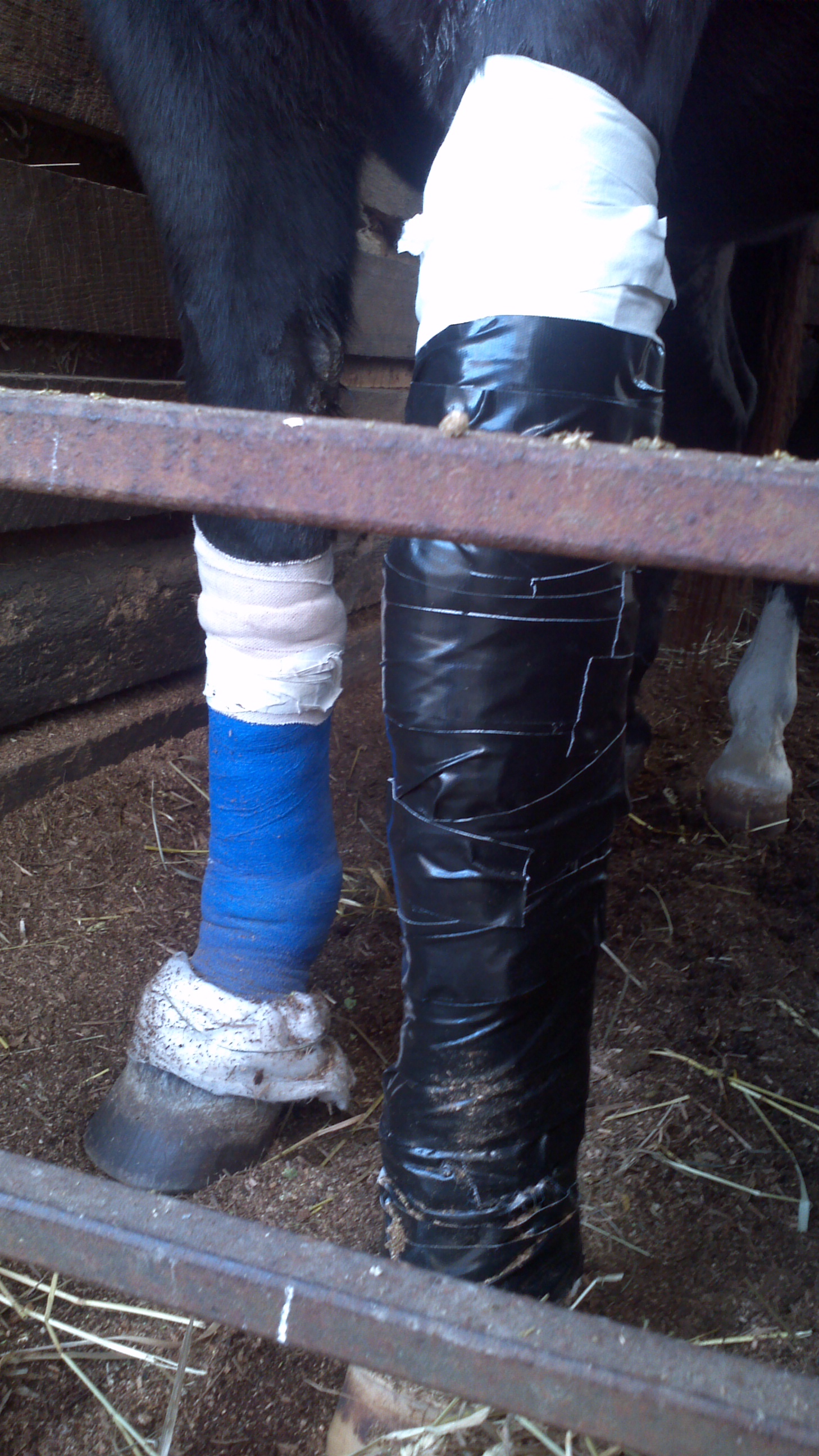
Fortunately, our regular vet Dr. H. was willing to work with us, though he was pretty certain what the outcome would be. So in the short run, we bandaged and splinted Midnight’s leg, and put a boot on the good foot to support the hoof and keep him from foundering on that leg because of the extra pressure.

2013-11-29_15-31-05_462The first several weeks were rough. Midnight was able to hobble around, and shortly, to walk around on his splinted leg. He never seemed distressed — his temperature and respiration remained normal the entire time. The problem was mechanical: He kept shifting the aluminum splint, probably by lying down (!), and every time it shifted, Dr. H. had to come out and reposition it. The bandage was way too complicated for us to do ourselves.

Midnight required a lot of daily care, too. Because he was stall-bound and not able to move around, there was a danger that he’d become bored. He’s a smart little guy, very active and interested, who thrives on attention. He also needed extra feedings — he can’t eat hay, and needs soaked forage cubes in order to keep things “moving” and to stay warm in the winter. So we were kept busy tending to him every day.

Eventually, Midders actually broke his aluminum splint. Needing a sturdy but lightweight alternative, we replaced it with one cut from PVC pipe. Success! He couldn’t break that one — but he continued to shift it every couple of days.

Vet calls get expensive fast! We were pretty frustrated, but then we decided to try Gorilla Tape instead of the vet tape that we had been using. That did the trick. Finally, we could go four or five or even seven days without needing Dr. H. to come by.

A month into the journey, Midnight began to develop pressure sores — an almost unavoidable consequence of the splint and bandage. Dr. H. was inventive and creative about the type of padding and the position of the splint, and that bought us just enough time: By Week Seven, it was clear that we had to remove the splint, whether the elbow was “ready” or not.

We shouldn’t have doubted Midders. He quickly adjusted to the lack of support, and was able to put at least some weight on the injured leg from the very beginning. As long as he stood square, we were able to lift his good front foot to clean it and replace the boot when we needed to.

It’s been almost twelve weeks now. Last week Dr. H. cleared Midnight for walking along the roads, and to begin to move around in a limited part of his paddock. And just in time, too: The day before that vet visit, Midnight had escaped his stall (he was READY to move!) and trotted off down the lane. It took a while to catch him!

So our little miracle horse is getting back to normal. He’s going for a walk once or twice every day, assisted by the intrepid members of Team Midnight. All of his pressure sores have healed and he’s doing amazingly well.

Midders has friends and supporters literally all over the world — through the wonders of Facebook and Carolyn Resnick’s network of students and trainers. We marshalled their healing energy and prayers, and I truly believe that they all share the credit for his wonderful recovery.

In the next post, I want to talk about the conscious and careful way we asked for that healing energy: There’s a specific technique that I believe was instrumental in the healing process. Stay tuned — and visualize the Mean Little Black Horse trotting around, tail in the air, happy and whole!

Back to School

What's in there (1)Galahad and I are going back to school in a couple of weeks—the fall session of Carolyn Resnick’s online Waterhole Rituals course is starting up the week of the 22nd. I’m excited to have a chance to take it again—we learned so much from the spring session. Galahad and I are very different together now. We have a much stronger bond these days, and he is feeling free to be himself.

One of the many changes that I love is the fact that we have “conversations” about interesting things going on, and that we listen to each other. Here’s a link with couple of little instances of what I’m talking about. This never happened before we started studying with Carolyn. I had no idea it COULD happen.

It’s not an easy thing to learn to be with a horse in that way. In Carolyn’s world, the horse has the right to choose not to do an activity. Instead of trying to make it happen, we’re taught to go back to something the horse enjoys, and stick with that until he’s ready to do the other thing. That could be minutes, days, or months.

When Galahad and I started the class last March, Carolyn could see right away how shut down he was, and “prescribed” lots of just spending time together, hanging out in the pasture or the paddock. And that’s mainly what we’ve done all summer—which was fine with both of us, since neither Galahad nor I deal with heat very well.

We did continue a little bit of work on the halter, just to keep his ground manners tuned up. Our rule is that when the halter is on, he plays by Natural Horsemanship rules. He’s very, very good at that, so that worked out fine.

When he’s at liberty in the pasture or arena, though, he gets to say no if he wants to. As long as he respects my boundaries so that I can be safe, he can do something when I ask him to, or he can choose not to do it. That’s the rule in liberty work. This has been interesting for us both, but especially for me. As with so many things, it’s easier to learn something the first time than to un-learn something you’ve practiced.

The hardest thing for me to re-learn is to be OK when I ask for something and Galahad says no. My knee-jerk, conditioned response is still to MAKE him do it, or at least to get him to do SOMETHING, even some small thing like yield his hindquarters, so that I can “end on a good note”—i.e., so that I can WIN. That’s the Natural Horsemanship way (and in that context, it’s fine), and more than that, it’s the dominance-based paradigm that I learned from my dad.

Sixty-two years of practice one way, and now I’m asking for a complete change in six months? Um, Kay, relax. You have time to learn this! Don’t be so hard on yourself.

On the other hand, over this same period of time I’ve found that my boundaries are much stronger with him. I don’t even blink when he’s being a pest and I wish he’d quit—I just send him off. And he goes, much more willingly than he used to, and without taking offense. He still watches me, and is just as happy to come back when I’m ready.

So this fall’s class will be interesting, as I learn more about myself. My horse, my teacher…. I’m really glad to have found Carolyn, who can help mediate this learning.